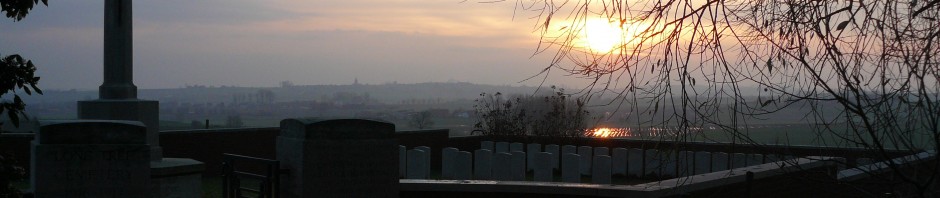

Australian graves in Shrapnel Valley. We started our look at the Great War cemeteries of Gallipoli last post by visiting the cemeteries at Helles. This time, we venture some fourteen miles north, as we begin our tour of the cemeteries at Anzac.

The initial landings at both Helles & Anzac took place on 25th April 1915, with a third at Suvla on 6th August. As the map shows, it was the Australians and New Zealanders – the Anzacs – who made up the troops landing at Anzac Cove. And it was here that the ANZAC legend was born.

Today, by far the majority of the CWGC cemeteries on the Gallipoli peninsula, twenty one of them, are to be found around the Anzac beachhead. British troops would later land in support at Anzac Cove; indeed only four of the cemeteries we are about to see over the next three posts do not contain British burials alongside the Australians and New Zealanders. The four Suvla cemeteries to the north will be the subject of a later post.

This map shows the landing beaches (shaded blue) and the trench system at Anzac, Australian trenches in red and Turkish trenches in black. Once established, nothing much would change for the duration of the campaign. The main features, some of which you will become familiar with as we continue, are all numbered from south to north, and luckily, on the right we have a handwritten list with which to identify them.

Australians being ferried to the beaches from the warships further offshore in steam pickets (left) hauling rowing boats (right) whose oarsmen would take over closer to land. The following photos show you the beaches on which the Australians landed (although not necessarily the beaches they were supposed to land on). From south to north,…

…dead mules on the shoreline at Brighton Beach south of Anzac Cove (left), a post-campaign view looking north along the same beach towards Hell Spit (right),…

…and two views of Anzac Cove, the most famous of the beaches, looking north towards the headland of Ari Burnu, on the left with troops arriving or departing, and on the right, post-evacuation.

Beyond Ari Burnu, to the north of Anzac Cove, this aerial shot shows North Beach, with Walker’s Pier, and the smaller Williams’ Pier, beyond. After the fighting of the first half of August, North Beach would be transformed into a major base – the tents in the foreground are those of the 1st Australian Stationary Hospital, those in the background the 16th British Casualty Clearing Station.

Williams’ Pier in the days prior to the Anzac evacuation in December 1915. The rock formation of the Sphinx towers above the beach, the cliffs on either side…

…riddled with dugouts cut into the rock.

List of the original Allied cemeteries (above & below) at Anzac, with details of the later concentrations. By the end of the war there were at least fifty cemeteries, large & small, scattered across the Anzac beachhead, an area covering just two miles in length and a maximum of about a thousand yards inland, and thus many of the, generally, smaller cemeteries would later be concentrated into the twenty one that remain to this day.

Post-war settlements between the warring nations meant that it was Greek children (left) who would find themselves photographed beside piles of human bones in the years immediately following the war, not young Turks. On the right, an Allied photo of dead Turkish soldiers, bayonets pointing skywards, lying in a trench. Whether or not this is the case here, it was not uncommon for a single trench to be manned by both Allied & Turkish soldiers, with a barricade between the two.

Nine of the cemeteries that remain were begun on, or in the immediate days that followed, the landings of 25th April (those shaded red) and one, Shell Green Cemetery (shaded green), in May, and it is the creation of these ten cemeteries that we shall be looking at this post, beginning with the two at either end of Anzac Cove, Ari Burnu Cemetery, and, first, Beach Cemetery.

Post-war shot of Anzac Cove looking south towards Hell Spit, and Beach Cemetery.

Beach Cemetery at the end of the war,…

…this the northern end of the cemetery, out of shot, far left, of the previous panorama.

Two views of Beach Cemetery not looking at all as shown in the previous two shots. Apparently, it was the Turks who added the stones to mark these graves after the Allied evacuation. Whether this happened across the whole peninsula I am unsure, but in some places Turkish troops had already used the crosses in the cemeteries as firewood after the Allied evacuation, and the cemeteries thus vandalised had in effect vanished from view. In 1916, when Pope Benedict XV sent an envoy to check on the state of the cemeteries, the Turks refashioned a number of them – presumably those on the envoy’s schedule – by adding mounds and stone borders. Although not necessarily in the right places.

The British Grave Registration Units had to use the original 1915 cemetery plans to locate the correct positions of the graves when they first visited the cemeteries in 1919. And as a consequence, some of these clearly marked graves from 1915 are now the graves of unidentified soldiers. Although not the graves beneath the crosses on the right, two of which are legible – Lieutenant Aubrey John Bickley Sherring, Australian Army Service Corps, killed in action on 31st July, and Serjeant Gordon Crocker, 8th Bn. A.I.F., who died of wounds on 28th July – as all can today be found in Plot II Row F,…

…and the grave of Private Martin McFlynn, also Australian Army Service Corps, who died of wounds on 23rd May, is now in Plot I Row E.

These graves can be found in the jumbled area in the centre of the cemetery (cemetery plan on left), although only two of the men named on the cross on the right appear to be buried here, whereas seven of the others are men now to be found close by in Shrapnel Valley Cemetery.

Beach Cemetery, here seen post-war with the Cross of Sacrifice under construction, was begun on the day of the Anzac landings, and was used until late October, the final burial being a man who died of wounds in mid-November. It contains almost 400 men, of whom all but 22 are identified, and eleven men are remembered by special memorials.

Beach Cemetery, Cross completed and headstone bases erected, although the name panels have yet to be added, hence the wooden crosses still in place,…

…and here with the headstones completed and the crosses gone.

Later shots; on the right, soldiers paying their respects in the 1930s.

Ari Burnu Cemetery, at the northern tip of Anzac Cove.

Looking north from Ari Burnu at wrecked shipping off the shore of North Beach,…

…and a slightly later shot of the same view.

The grave of six troopers of the 8th Australian Light Horse, killed in action on 7th August 1915, in Ari Burnu Cemetery. The first burials, three men, two New Zealanders and an Australian, were made here on 27th April, after which the cemetery was used regularly until early August, and then sporadically until November, the final burial being made on 11th December 1915. At the time of the evacuation, 252 men had been buried here, all but 42 identified.

Five men believed to be buried here are remembered by special memorials, and thirteen men who died in 1918 & 1919 and were originally buried elsewhere were moved here in the 1920s. The men listed on the left were moved from the Anglo-French cemetery at Kihid Balar* in 1925, the three on the right from Gallipoli Consular Cemetery, having died in 1919.
*This probably refers to the Morto Bay French National Cemetery at Seddülbahir, Helles.

Ari Burnu Cemetery, Cross of Sacrifice erected and headstones in place.

Servicemen pay their respects at the Cross of Sacrifice, Ari Burnu Cemetery, 1923.

The Sphinx and the cemetery. On the right, the cemetery plan.

Graves at Ari Burnu. Possibly.

Just two hundred yards north east of Beach Cemetery, this is Shrapnel Valley Cemetery, with more Turkish additions, in the form of stones, to the Allied graves.

Shrapnel Valley (or Gully, as on this map) was a crucial arterial route from the beach to the Anzac front line positions, and was heavily shelled by the Turks, gaining its name from the first Turkish bombardment on 26th April 1915. Its upper reaches became known as Monash Gully, with Pope’s Hill, pictured below, at the valley’s end.


View looking down the lower reaches of Shrapnel Valley, with the drain travelling down the length of the valley, cut to protect the route up to the front line posts, quite evident. Men using this route each day, supplying the front line troops, knew that their journey would involve a hot and tiring trek with Turkish shells scattering shrapnel all around, and with little or no cover to be found.

Shrapnel Valley Cemetery soon after the evacuation (left), and on the right, the later cemetery plan.

Original panoramic shot of the post-war cemetery.

Of the 683 men buried or commemorated here, most were already interred before the evacuation,…

…although a few battlefield burials were brought here post-war.

Here the Cross of Sacrifice & the Stone of Remembrance are now in place, as are the new headstones, although the crosses remain.

Crosses now removed. 85 of these burials are unidentified, and there are 23 special memorials to men buried among them.

Australian soldiers visit old comrades at Shrapnel Valley after the war (left), and on the right, the grave of Private Henry Heath Sykes, 8th Bn. Australian Infantry, killed in action on 20th August 1915. And those are Turks standing behind the grave (and milling around in the background, unless that’s the Pope’s envoy and entourage?), perhaps the men who added the stone borders to the graves (more below), just as we saw in Beach Cemetery earlier.


Another view of the Sphinx; the rugged nature of the land within yards of the beach at Anzac – why anyone would choose such a coastline for a seaborne landing is beyond me – is 4clear to see. On the far right, Plugge’s Plateau, captured by the Australians on 25th April 1915, the day of the landings,…

…would later become the site of a small cemetery of just 21 men, seventeen of whom are identified (twelve Australians & five New Zealanders).

Frost damage and repairs to the Cross of Sacrifice at Plugge’s Plateau Cemetery, January 1924.

View of Plugge’s Plateau on the left, with Pope’s Hill, at the end of Monash Gully, centre right. Plugge’s Plateau Cemetery plan on the right.

A small cemetery was created here on the lower slopes of Pope’s Hill, despite being in full view of Turkish trenches on Dead Man’s Ridge (top right).

The men buried here were nearly all Australian, and after the war, the burials in this cemetery would be concentrated elsewhere, as we shall see in a later post.

The next cemetery on the map is 4th Battalion Parade Ground Cemetery, seen here at the war’s end,…

…and here pictured in 1922. Originally a burial ground containing just 40 Australian casualties, the cemetery was enlarged when men buried on the battlefield or in a couple of smaller cemeteries were concentrated here post-war. Today 4th Battalion Parade Ground Cemetery contains 116 men, seven of whom are unidentified.

Another view of 4th Battalion Parade Ground Cemetery (cemetery plan on the right), with Shrapnel Valley Cemetery further down the valley in the background,…

…and a later view taken in the 1950s.

These Australian graves, thirty four men all killed on 19th May, would later be concentrated in 4th Battalion Parade Ground Cemetery,…

…as would the sixty six burials in 3rd Battalion Parade Ground Cemetery.

Courtney’s Post Cemetery, according to the original annotation to this photograph,…

…and later Courtney’s & Steele’s Post Cemetery. Both Courtney’s Post & Steele’s Post were positions taken on 25th April, the day of the landings, and both would be held throughout the campaign.

Troops digging trenches at Courtney’s Post (left), and dugouts on the reverse slope at Steele’s Post (right). The firing line, in each case, was at the top of the slope.

The boundary walls at Courtney’s & Steele’s Post under construction, crosses still marking the graves,…

…and here replaced with headstones. Of the 225 men buried or commemorated here, 160 are unidentified, although there are 58 special memorials to men buried among them.
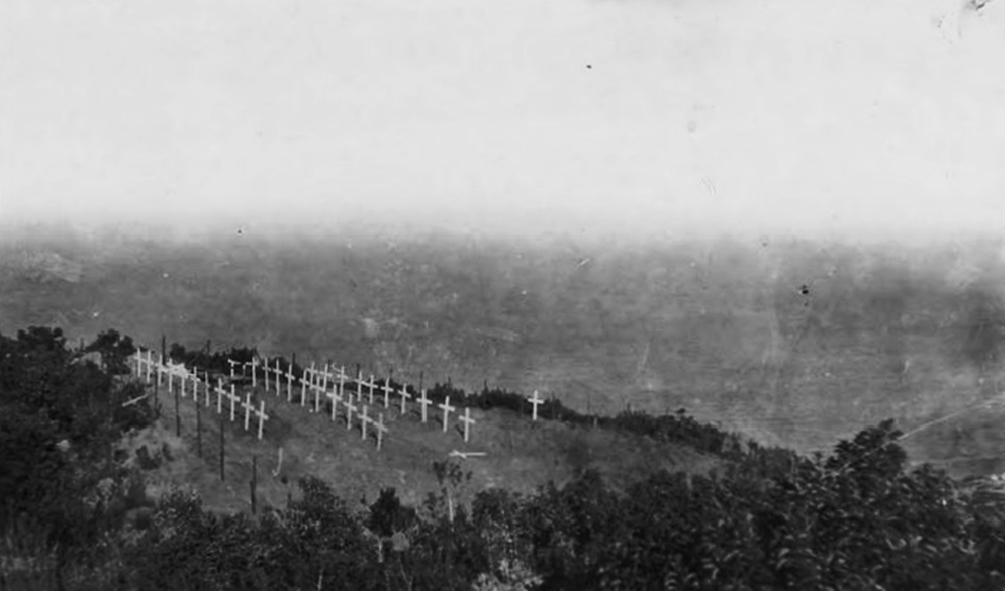
Walkers Ridge Cemetery (above & below). Walker’s Ridge was taken on 25th April and would become the command post of the New Zealand Infantry Brigade.

Although the Turks would attempt to recapture the ridge, it would remain in Allied hands throughout the campaign.

Walker’s Ridge Cemetery under construction.

The cemetery, begun in April, was used until the end of May and then again in August & September, with a few burials made later in the year. Apparently, there was once a trench that ran through the cemetery, separating the two plots that exist today. That must have been pleasant for the men manning the trench. Sixteen of the 92 burials are unidentified, and 26 of the identified men are remembered on special memorials.

This view looks north, Suvla Bay beyond the promontory on the horizon, and shows three cemeteries at the war’s end. The large white square in the centre mid-distance is Embarkation Pier Cemetery, a mainly post-Armistice cemetery that we shall look at later, the cemetery closest to the camera in the foreground is No. 2 Outpost Cemetery, and the small oblong burial ground between the two is New Zealand No. 2 Outpost Cemetery. Had we been down there in August 1915,…

…this is the view we might have seen, looking south towards the Sphinx and Anzac Cove beyond the promontory of Ari Burnu,…

…and this the view looking up into the hills. Note the battered graves in the left foreground.

New Zealand No. 2 Outpost Cemetery at the war’s end.

New Zealand No. 2 Outpost Cemetery is an unusual cemetery in that it was originally one long grave, as the cemetery plan on the right shows. The 33 identified men now buried here, with just two exceptions, died between 6th & 10th August 1915,…

…the names of most of them, and their dates of death, listed here. There are Australians, New Zealanders & British casualties buried here, and a further 150 men are unidentified, although 31 special memorials remember men believed or known to be buried among them.

No 2 Outpost Cemetery at the war’s end,…

…and only a few years later.

The first burials were made here by the Australians on the day of the landings, 25th April, and the cemetery was used into early September. 152 men, of whom 88 are identified – 44 Australians & 44 New Zealanders – are buried here, 48 of whom are remembered by special memorials.

Graves at No. 2 Outpost, August 1915. And the cemetery plan.

Hospital barge moored at Walker’s Pier at North Beach late in the campaign*. The 1st Australian Stationary Hospital (foreground) had only moved to Anzac from Lemnos in early November 1915, at a time when the intention was still to hold the ground gained at Gallipoli through the winter months.
*these self-propelled hospital barges, used to ferry wounded to the bigger ships offshore, were known as ‘beetles’.

Gallipoli was very hot, but Gallipoli could be very cold too. Rising tides and high winds begin to batter Walker’s Pier in advance of the blizzard that hit on 26th November.

For two days the whole peninsula froze, causing many cases of frostbite, and numerous deaths from exposure. Here, a burial party attempts to dig graves in a snow-covered cemetery.

Storm damage and wrecked piers (left), and all repaired (right). In the right background, one of the British cruisers that provided artillery support for the troops ashore.

Shell Green Cemetery, the green square on our map, and the furthest south of the Anzac cemeteries, was originally two adjacent cemeteries, Shell Green No. 1 Cemetery,…

…now in the background of this shot, and Shell Green No. 2 Cemetery, here in the foreground.

Original panorama showing Shell Green Cemetery Nos 1 & 2.

Shell Green Cemetery, with Turkish additions,…

…before construction work on the walls had begun. Shell Green had been taken by the Australians on the morning of 25th April, but remained close to the front lines throughout the campaign and subject to frequent Turkish artillery fire. The cemetery was begun in May 1915 and used until the evacuation in December.

This shot, taken in 1923, shows both cemeteries before graves were moved here from a number of smaller cemeteries, along with men found on the battlefield, combining the two sections. Today there are 409 burials in the cemetery, all but eleven identified.

Shell Green Cemetery, the Aegean Sea beyond, and the cemetery plan.

The cemetery also contains the grave of Lieutenant Colonel Hubert Jennings Imrie Harris, 5th Light Horse (pictured below), one of the highest-ranking Australian officers killed on Gallipoli, his original cross shown in both these photos.


A burial service somewhere in the Anzac hills. At which point we shall end the first part of this look at the Anzac cemeteries. There will be more.
Thanks again M for this brilliantly detailed report and the photographs of the time. Despite the dreadful conditions it’s wonderful to see the care given to the burial of those who were killed, this must have taken some considerable research
Yep M, took many months to source this stuff and put it all together, so thanks ever so. The next Anzac post is already published, with two more Gallipoli posts on the way. And the bullet was bitten yesterday and delivery is now awaited.