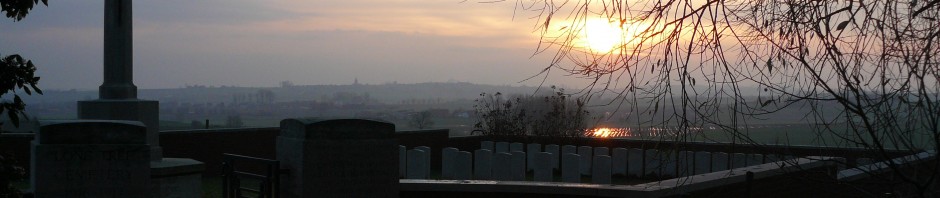

On the other side of the road, opposite Dickebusch church, a small military cemetery contains just forty six Great War burials.

Dickebusch was around three miles behind the front lines throughout the war, and men killed or mortally wounded in the front lines were brought back here for burial.

The cemetery was only used for three months at the start of 1915; by February 1915, burials were already being made in the New Military Cemetery, just down the road.

So, if you take a look at the cemetery plan at this point, what you will not find are four rows of headstones. You will find just three. The reason being that the row on the far left,…

……Row AA, consists of Second World War casualties, these men all killed in late May 1940 during the Allied retreat to Dunkirk, some twenty five miles to the north west. Long after the cemetery plan was drawn up.

One man among them (far right), of four men killed on 24th May, is unidentified,…

…the others, including five artillerymen (four pictured here), died on 28th May, except the East Surrey corporal on the far right, who was killed the following day.

The Great War graves seen here in the rows behind are noticeably widely spaced, the men buried at a time when there was still no conception of how many burials would eventually have to be made, not just here, but across Flanders’ Fields. In the foreground on the right, in what is the second (of three) sections of Row A,…

…the grave of Private David Henry Cranston, Royal Irish Fusiliers, who died of wounds on 13th February 1915 aged 21,…

…his grave now fourth in line as we look back along the same section of the row. The headstone in the foreground is that of Private F. W. Bright, one of two Royal Irish Fusiliers buried in the row who died on 14th March 1915. In the background, we’ll visit the final group of headstones in the row later.

Turning round, the closest headstone…

…marks the grave of Lance Corporal William John Huston, P.P.C.L.I., who died on 25th January 1915 aged 38,…

…his headstone now on the far right. Next in line, a Royal Scots private who died six days later,…

…followed by, on the right, one of two Bellinghams buried in this cemetery, this man an Argyll & Sutherland Highlander private, with, in the centre, the second Royal Irish Fusilier private who died on 14th March 1915. Only one further burial would be made here, much later in the year, after this date. On the far left, the first burial in the row,…

…is the grave of an unknown German soldier. No name, no date. No identity. But somebody’s husband, somebody’s son. Always sad.

A somewhat foreshortened view looking back along the whole of Row A, with the Second World War burials of Row AA on the right.

Cross of Sacrifice & courting couple.

Looking back down the cemetery, the entrance in the right background. The area directly in front of us once contained seventy eight French graves, moved elsewhere post-war. Out of shot to the right behind the tree,…

…the ‘In Perpetuity’ tablets are laid on a pedestal inside the northern cemetery boundary, in line with the Cross.

The three headstones behind the Cross include two special memorials,…

…on the left Captain Roger Charles Noel Bellingham, R.F.A., Mentioned in Despatches, who died on 4th March 1915 aged 30, and in the centre Second Lieutenant Valentine D. French, King’s Shropshire Light Infantry, who died on 17th June 1915. The third headstone marks the grave of Private B. W. Price, Gloucestershire Regiment, who died on 17th February 1915.

Captain Bellingham & Second Lieutenant French were among three men buried across the road in Dickebusch churchyard, and the cemetery register (above) tells us quite clearly where they were located. Or where they were believed to be located, perhaps,…

…because when it was decided, in 1962, to move the occupants of the three graves into the nearby Old Military Cemetery, only one body could be found (we’ll see his concentration grave later), and the remains of both Bellingham & French (both pictured above) seemed, and indeed were, lost. Referring to both men, the GRRF on the right states, ‘These officers not found. Kipling memorials to be erected in Dickebusch Old Military Cemetery’.

Thus, today, both headstones are inscribed at the top with ‘To the Memory of’.

Cross of Sacrifice again, and beyond,…

…three officers at the start of Row B, on the left, Lieutenant John Dutton Calvert, The Rifle Brigade, aged 23, and in the centre, Major Percy Thomas Charls Baird, Cameron Highlanders, aged 43, both men killed in action on 15th February 1915. On the right, the third man once buried in the churchyard, his name on the documents we just looked at, and the only one actually reburied here, Captain Denzil Onslow Cochrane Newton M.V.O., P.P.C.L.I., who was killed in action on 9th January 1915.

Looking north east, showing the proximity of the cemetery to the church.

We’ll visit the graves in Row C before we return to Row B, the longest row of the four.

The men in Row C, barring one, are all casualties from mid-February 1915, and this shot includes, second from left and furthest right, closest to the camera, both of the unidentified British Great War burials to be found in the cemetery.

The row continues with the graves of Private J. Jacob, Royal Irish Regiment, who died on 13th February 1915,…

…and Major William Hawtrey White, Royal Irish Regiment, Mentioned in Despatches, who was killed in action on 14th February 1915, aged 42.

Company Serjeant Major William Norris, The Rifle Brigade, at the end of the row, died of wounds on 10th March 1915, slightly later than the other burials in the row.

And no, I haven’t forgotten about the rest of Row B.

The burials in the row are all from February…

…or from the second half of January 1915.

The grave of Lieutenant George Eric Guy Stacpoole, Royal Irish Regiment, who died on 27th January 1915, aged 23,…

…and the remaining headstones in the row.

The final burials we have yet to see in the final section of Row A include three Royal Field Artillery men killed on 14th February 1915, with a much later burial, the final Great War burial made here, that of a Queen’s serjeant major who died on 13th November 1915, eight months after the previous two burials, on the far left. And behind these men, to the right of the tree,…

…the final burial in Row B, Private S. Little, East Surrey Regiment, who died on 9th February 1915.

‘This cemetery was built and is maintained by the Commonwealth War Graves Commission’. And good on ’em. You might be wondering why this little burial ground was not concentrated into one of the numerous larger cemeteries after the war, as the majority of cemeteries with fewer than fifty burials were, and I have no answer, except that maybe its proximity to the church and churchyard ensured its continued existence.

We saw the Y.M.C.A. huts at Reninghelst a few posts back, and here’s the Y.M.C.A. establishment in Dickebusch, front,…

…and presumably back.

1917 map & aerial photographs of the north (above) & west (below) of Dickebusch Lake. The scarcity of information on the map extracts is, for very good reasons, striking when compared to the hubbub of activity seen in the photograph.

The moated chateau…

…is probably the same as that seen in the background of this shot, looking across the lake, taken on 21st November 1918.

Map and a snowy aerial shot showing the very northern tip of the lake at the bottom, and the start of the canal that winds its way north and then east for two and a half miles into the heart of Ypres (Ieper).

This being the Old Military Cemetery (in red, just beyond the church in the foreground), you would expect to find a New Military Cemetery close by, and indeed there is, here marked in orange. We’ll take a look next post.
As ever, thankyou again, Magicfingers.
Thank you, as always, Kath.
Thanks M an interesting post as always, so intriguing these smaller cemeteries, as to why some remained and others were condensed but all beautifully maintained.
Me too. Literally just back from an excellent trip. And as on most of my previous trips, glorious weather. Was back in Dickebusch on Friday, actually.