
A glorious March afternoon in the Surrey hills.

In a cemetery, in the Surrey hills, to be exact, and on the lookout for a single burial among this lot.

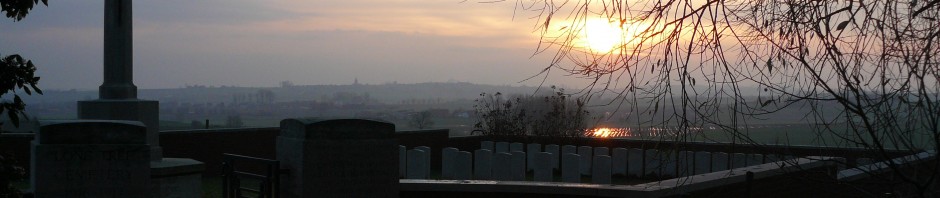
Or maybe over here somewhere, these two photos (above & below) taken on a greyer day some years ago.


And I nearly gave up, before I realised that it was staring me in the face.

The headstone on the left…

…marks the grave of Sergeant Charles Graham Robertson V.C., M.M., Royal Fusiliers.

Born in Penrith in Cumbria in 1879, but educated down south in Dorking in Surrey, he served with the Middlesex Yeomanry during the Boer War at the turn of the century, re-enlisting in 1915 in the 10th (Service) Battalion, Royal Fusiliers. One of the Pals battalions, and unofficially known as the Stockbrokers, the 10th Bn. was formed in the City of London in August 1914 as part of Kitchener’s Army. Wounded in April 1917 at the Battle of Arras, Robertson recovered and returned to the front in August, receiving a Military Medal by the end of the year.

He was a lance corporal when awarded the Victoria Cross for his actions near Ypres on the night of 8th/9th March 1918, the citation for which reads, ‘For most conspicuous gallantry and devotion to duty in repelling a strong attack by the enemy on our position. On realising that he was being cut off, L./Cpl. Robertson sent back two men to get reinforcements, and remained at his post (with only one other man), firing his Lewis gun and killing large numbers of the enemy, who were in range on his right. No reinforcements came up, and, realising that he was being completely cut off, he withdrew with the only other survivor of the garrison of the post, to a point about ten yards further back where he successfully held his position.

Here he again stayed for some considerable time, firing his Lewis gun and inflicting casualties on the enemy. The position was, however, made impossible for him by the heavy hostile bombing and machine-gun fire, so he was forced to again withdraw and arrived at a defended post. At this post he got on top of the parapet with a comrade, mounted his gun in a shell-hole, and continued firing at the enemy, who were pouring across the top of and down an adjacent trench. He had not been firing long when his comrade was killed, and he himself severely wounded. He managed to crawl back, bringing his gun with him, but could no longer fire it, as he had exhausted all his ammunition. L./Cpl. Robertson was alone throughout these operations, except for the presence of one other man who later was killed, and the most determined resistance and fine fight which he put up undoubtedly prevented the enemy from making a more rapid advance. His initiative and resource, and the magnificent fighting spirit, are worthy of the highest praise.’

Surviving the action, Robertson was hospitalised (left) but recovered enough to later serve as a sergeant in the Home Guard in the Second World War.

He would die in 1954 at the age of 74.

The CWGC graves in the cemetery (the man in the foreground another M.M. recipient), and lots more, can be found by putting ‘Dorking’ in the search box. Me, I’m off for a couple of days strolling around Flanders’ Fields tomorrow. See ya!
Why is the VC before the MM? He recieved the MM first? Just curious. Thank you
Not an entire expert on this but I think you always start with the highest honour you’re given no matter which order you earned them in- because it’s the most important it is always listed first.
I must check chaps on our war memorial to see if that is how the awards are listed. Thank you
V.C. comes before any other letters, of any sort, that you may have after your name.