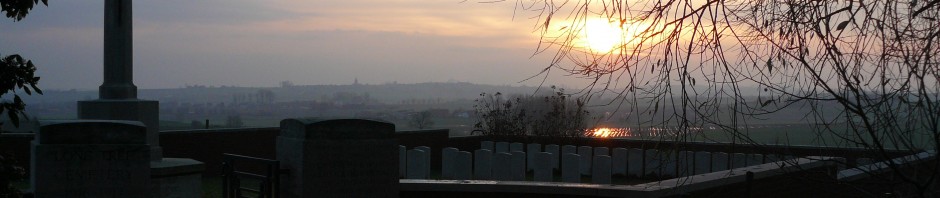

Just a hundred yards south of Dickebusch church, we have another cemetery. Or two cemeteries, to be strictly accurate, one on either side of the road.

On the left, Dickebusch New Military Cemetery, and on the right, with the Cross of Sacrifice, Dickebusch New Military Cemetery Extension.

Composite map from February & April of 1917 and comparison photo taken on 8th August the same year, Dickebusch in the foreground and the southern part of Dickebusch Lake in the middle distance. On both map & photo, the Old Military Cemetery we visited last post is marked in red, and what was known as Ridge Wood, in green.

And I show you Ridge Wood because that was as close as the Germans would get to Dickebusch during their advance in the spring of 1918. These map extracts show the front line a short distance to the east of the wood on 11th May 1918 (thick blue line) on the left, and running through the wood exactly two months later, on 11th July 1918, on the right, as the British trenches (in red) meet their German counterparts in the wood itself. Should you wish to visit the CWGC cemetery, just behind the British front line at Ridge Wood, click here.

A closer look at the bottom right of the earlier photo shows Dickebusch church in the foreground, with the Old & New Military Cemeteries now marked in red & green respectively, and part of the Extension added in orange.

The Cross in the Extension serves for both cemeteries, as does the Stone of Remembrance…

…in the north western corner of the New Military Cemetery,…

…beneath which the cemetery name – both cemeteries – can be found. We shall be concentrating on the New Military Cemetery this post, so all data refers only to this side of the road.

The New Military Cemetery consists of a single plot of fifteen rows of burials, thirteen of which cross the entire cemetery, and two which are considerably shorter in length. All of which makes it quite tricky to show you around, as one row looks much like the next. But we’ll give it a go.

There are 624 men, of whom just six are unidentified, buried in this cemetery. The majority, 521, are British, and the cemetery was used, at times regularly, at times more sporadically, between February 1915 & June 1917.

As the headstones all face away from us we could, as we often do, head for the bottom of the cemetery and work our way back up to the top, but on this occasion, with the earliest burials at the top of the slope, we’ll start here.

Among the nearest burials to the cemetery entrance are the graves of Captain Percy William Norman Fraser D.S.O., Cameron Highlanders, who was killed in action on 22nd February 1915 aged 36,…

…and Major Frederick Sutherland Lillie, Royal Irish Regiment, killed in action at St. Eloi on 15th March 1915 aged 42,…

…Lillie’s headstone seen again here on the left, the two other graves…

…those of Second Lieutenant Henry Bethune Campbell, Argyll & Sutherland Highlanders, killed in action on 23rd February 1915 aged only 18, and next to him…

…the earliest burial in the cemetery, Lieutenant Robert Stirling, also Argyll & Sutherland Highlanders, who died on 19th February 1915, aged 22. Although a few burials were made later, 19th February was also the final day that the Old Military Cemetery was used on a regular basis.

The majority of the burials in Row A on the right are from February or March 1915, with a few men killed in December 1915 and the first days of January 1916, and some 1917 casualties added at the far end, as we’ll see later.

The second row, Row AA, however, consists entirely of burials from March & April 1917,…

…the graves slotted in between Rows A & B,…

…with the exception of three artillerymen closest to the camera here who were all killed on 16th April 1918, presumably somewhere very close by, and were added to the start of the row. There are only four burials from 1918 here, the other in Row BB.

Across the cemetery, these headstones in Row A…

…are seen again here on the left, the final five burials in the row men killed in April & May 1917.

Row AA contains the most burials, fifty six, of any of the rows in the cemetery. The majority of the casualties buried in Row A died in February or March 1915, and 23 of the 49 burials in Row B are also men killed in March 1915. Those in Row AA are all men killed in the spring of 1917, apart from the three men who died later in 1918, the row being added two years after many of the men in the rows on either side had been buried.

A Queen’s private killed in action on 6th May 1917 at the end of Row AA, alongside a Kent Cycling Bn. private, transferred to the Royal West Kent Regiment, after which lie more men of the Royal West Kents, all killed on 7th April 1917,…

…with another on the left here, killed in action on 5th April, next to two sappers who died on 6th April 1917.

Still in Row AA, on the left, Second Lieutenant S. H. Morgan, East Surrey Regiment, attached to the 122nd Trench Mortar Battery when he was killed in action on 4th April 1917 aged 30, and on the right, Lance Corporal David Marshall D.C.M. (pictured), King’s Royal Rifle Corps, who also died on 4th April 1917, aged 34. While attached to 122nd Trench Mortar Battery he was awarded a D.C.M., gazetted on 27th July 1916, ‘For conspicuous gallantry. During an intense bombardment of the enemy Ptes. Rumsey and Marshall dug out and got into safety three wounded comrades who had been buried in a ruined house. They were under heavy fire for one and a half hours while working.’

View from behind Row B looking east down the cemetery.

Twenty three of the burials in Row B on the left are men who died in March 1915, most of the remainder men killed in May or June 1917, the graves of many of these later casualties interspersed among the 1915 burials.

Bombardier C. E. Blatchley, Royal Garrison Artillery, killed in action on 12th May 1917, aged 25. A sad epitaph.

The big guns (above & below). A Royal Garrison Artillery 12-inch howitzer (Mark I) on a railway mounting in action near Dickebusch on 14th June 1916.


The final burials in Row B, the Middlesex Regiment private in the foreground killed on 4th May 1917.

One of two shorter rows in the cemetery,…

…Row BB contains thirty three burials and, like Row AA, was added some time after the majority of the burials in the rows on either side, those within, barring a single March 1918 casualty later added to the end of the row, all from April & May 1917.

The majority of the burials in Row C, twenty five out of thirty nine, are from March or April 1915, with seven from the spring of 1917, and a few from early January 1916. Sixth headstone from the camera,…

…J. M. Dodds served under the alias of Private J. Morton, Middlesex Regiment, and died on 28th May 1917, aged 40.

Looking back down Row C, and turning to our left,…

…the final graves in the row are two Royal West Kent men, both of whom died on 7th April 1917,…

…with more April 1917 burials in front at the end of Row D.

Unusual headstone further along Row D. Lieutenant Robert William Sterling, Royal Scots Fusiliers, was killed in action on 23rd April 1915, and his headstone is inscribed with all sorts of unnecessary stuff about him, which I thought wasn’t allowed,…

…but apparently all was above board. The headstone also tells us that his brother, Second Lieutenant John Lockhart Sterling, also Royal Scots Fusiliers, had been killed in action at Loos on 28th September 1915, his name to be found on the Loos Memorial.

Serjeant Drummer William John Stevens, Lincolnshire Regiment, killed in action on 27th April 1915, aged 39.

Still in Row D, although here looking over the headstones of Row E, one headstone that I failed to photograph, but I should have done, is shaded in red in this shot. The body of Lance Corporal Joseph Stanley Victor Fox, Wiltshire Regiment, lies beneath that headstone. In October 1914, Fox and several men were ambushed while on cycle patrol and forced to abandon their cycles and swim a canal before regrouping and later recovering their bicycles. They returned to camp minus Lance Corporal Fox, who was next seen in February 1915 when he was placed under arrest after giving false details to an officer when challenged. At his subsequent court-martial, Fox maintained that his absence at the time of the action was due to circumstances outside his control, and his absence over the next three months was due to his fear of being shot for being absent, as he had heard tales of others suffering such a fate. Indeed. Found guilty, he was shot for desertion here at Dickebusch, despite his acknowledged previous good character, on 20th April 1915, aged 20. Oh, the irony of the inset newspaper report.

Continuing along Row D, this is the grave of Lieutenant Colonel James William Alston, Mentioned in Despatches, Royal Irish Rifles, who died on 15th April 1915 aged 41,…

…and the headstone closest to the camera here is that of Company Serjeant Major Charles Ritson Neale, South Lancashire Regiment, who died of wounds on 11th April 1915 aged 21,…

…his headstone now fifth from the camera in this shot looking along the length of the row.

All but a handful of the burials in Row E are from May or June 1915, and include…

…Captain Samuel B. Stirling-Cookson, Royal Scots Fusiliers, who was killed in action on 17th May 1915 aged 23,…

…and Captain Edgar Nathaniel Loftus Brock, Worcestershire Regiment, who died on 20th May 1915.

Two of the six unidentified men buried here lie alongside each other in Row E,…

…close to these three casualties from early June 1915, from left, Private Joseph Whitehurst, Cheshire Regiment, who died on 2nd June aged 29, and two subalterns, Second Lieutenant K. R. Fowler, R.F.A., & Second Lieutenant V. Murray Drummond-Fraser, Cheshire Regiment, aged 21, both of whom died on 3rd June.

Panning across the cemetery (above & below), Row F in the foreground,…

…and the second of the shorter rows, Row G, in the left background.

With another of the unidentified men buried here in the centre of this shot (close-up below), on the right, at the start of Row F, a Devonshire private who died in June 1915, and on the left, Second Lieutenant Edward Alfred Mount, Royal Fusiliers, killed in action on 4th January 1916, aged 23.


Looking south along the rear of the headstones of Row F,…

…and now north towards Dickebusch church down the corridor between Row F (left) & the shorter Row G on the right. Most of the burials in Row G are men killed in February, March & April 1917, although half a dozen late 1915 casualties are buried towards this end of the row, where the headstones are spaced wider apart. Why there are two shorter rows in the cemetery I have been unable to ascertain, although the usual reason is that originally there were other nations’ burials, moved elsewhere after the war, completing such rows.

Two South Lancashire Regiment casualties in Row G, on the left, Private W. Pickering, who died on 26th September 1915, and on the right, Captain Norman Briggs Antrobus, killed in action on 2nd October 1915 aged 22.

Most of the burials in Row H (above & below),…

…are from the early months of 1916.

Near the end of Row H, the grave of Private John Blackadder, Royal Scots, killed in action on 23rd March 1916, aged 25. I hope Baldrick saluted.

The final six rows, Rows H to M, seen from one side of the cemetery,…

…and from the other.

Graves in Row I. Private E. Stanford, Suffolk Regiment, who died on 28th March 1915, alongside another of the unidentified men buried here,…

…Private John Howard German, 28th Bn. Canadian Infantry, who died on 7th April 1916, aged 31,…

…and two R.F.A. officers, both of whom died on 6th April 1916; on the left, Second Lieutenant Harry Mortimer Stacey Barrett, and on the right, Captain Leopold Loewe.

Canadian casualties in Row K, in the foreground, and in Row J behind.

Eighty four Canadians are buried here, all but three killed between March & August 1916, the majority buried in Rows J, K (above) & L.

Further along Row K, the grave of Gunner George Alexander MacDiarmid, Canadian Field Artillery, who died on 13th June 1916 aged 27; he hailed from Massachusetts, explaining the Stars & Stripes. George MacDiarmid has not been forgotten.

More Canadians, and two of only eleven Australians buried here (left & centre right), all of whom are autumn 1916 casualties, and all of whom are to be found in Row L.

View from the cemetery’s south eastern corner, the Stone of Remembrance in the right distance in the north western corner, and the Cross of Sacrifice, across the road in the Extension, left of centre. Row M is in the foreground, and behind, in Row L,…

…the burials at this end of the row, an R.F.A. gunner (see below) & two Middlesex Regiment men, are all from January 1917 (note the Canadian burials in the rows behind).

The artilleryman buried at the end of Row L is Gunner Alfred William Goodwin, R.F.A., killed in action on 16th January 1917 aged 21.

Two machine gunners who died in February 1917 bookend a collective grave containing the remains of five men of the Royal Irish Rifles killed on 24th May 1915, buried beneath three headstones, the Latin cross on the centre headstone serving for all three.

The remains of the five men are all buried at the same grave reference, L26, highlighted here in red.

View from the cemetery’s south eastern corner,…

…the burials in Row M (above & below) all from late 1916 or the early months of 1917.


The grave of Lance Corporal Frank Pankhurst, Queen’s Own (Royal West Kent Regiment), transferred from the West Kent Yeomanry (Queen’s Own), who was killed in action on 13th February 1917, aged 25,…

…and close by, four more men of The Queen’s Own (Royal West Kent Regiment), three killed on 11th February 1917, the private closest to the camera the previous day.

Left & centre, early January 1917 casualties, K.R.R.C. & London Regiment, and on the right,…

…two more R.F.A. men, both killed on 2nd January 1917.

Looking down the rest of the row,…

…and back the other way, the three headstones on the far right,…

…men of The Queen’s (Royal West Surrey Regiment) who died on 15th November 1916.

The row begins with three men who died in mid-November 1916.

The headstone in the centre, if you look closely, is actually a special memorial to a lance corporal of the Dorsets who is ‘Believed to be buried in this cemetery’.

Back on the road,…

…the ‘In Perpetuity’ tablets are inlaid into the exterior wall of the cemetery.

Next, surprise surprise, we nip across the road to visit Dickebusch New Military Cemetery Extension.
As ever, thank you for your work.