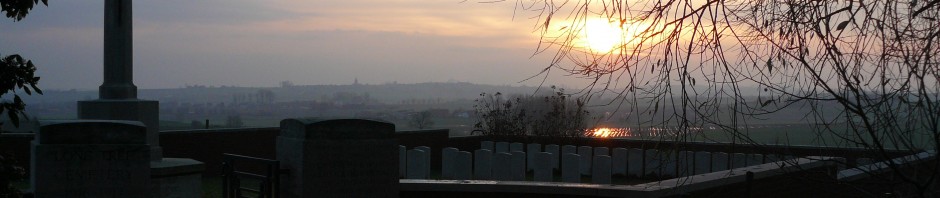

So here we are in the fields on the eastern side of the Yser Canal, looking west towards the spire of Boesinghe church, some three quarters of a mile away on the other side of the water. Continue reading
So here we are in the fields on the eastern side of the Yser Canal, looking west towards the spire of Boesinghe church, some three quarters of a mile away on the other side of the water. Continue reading

This is the third, and largest, example of a Schwere hand grenade that I can show you, and this is a seriously big piece of kit, weighing in at just under three pounds, and measuring almost five inches from tip to toe. Continue reading

This is a medium Schwere hand grenade, weighing in at about ten ounces, considerably heavier than the previous Schwere I showed you. Continue reading

Schwere hand grenades, made of cast-iron, and in quite a number of different styles and sizes, were used by Austro-Hungarian forces throughout the war. Continue reading

Three examples of what are known as Lakos hand grenades, named after the man who developed them, one Captain Róbert Lakos, pioneer officer of the Royal Hungarian 4th Honvéd Infantry Regiment.

The Lakos was basically an improvised grenade made in a variety of different sizes, but just one basic form.

Get hold of a steel cylinder, add grooves for better fragmentation,…

…seal one end,…

…and then fill with a charge bag full of explosives.

Add a wooden block at this end (I believe the really cheap ones had wooden blocks at both ends),…

…this one even having a small rim inside the cylinder for the block to rest on, and then, in these early examples, simply insert a fuse in the middle of the wooden block, light it and, after the requisite pause, throw it. And then duck.

The third example, probably a later version, is fitted with a cap. I doubt if the two other versions ever had caps, but as is the nature of improvised weapons, there were many variations on the basic theme to be found.

In this particular Lakos, though, the cap would have protected a percussion fuse embedded in the wooden block.

Remove the cap,…

…strike the fuse firmly on a hard surface (or perhaps use a specially devised igniter, which we shall at least see a diagram of in a future Lakos post – there’s a link at the end of this post), igniting the delay, and throw!


Seven-grooved Lakos, eight-grooved Lakos, and six-grooved Lakos (my nomenclature, but why not?). It seems that these grenades are not so hard to come by on the battlefields of the Italian front even today, mainly because they so often failed to explode, either the fuse failing, or the explosion simply blowing the wooden block out of the end at extremely high velocity. As with many Austro-Hungarian grenades, the Lakos grenade could be adapted for use as a rifle grenade, with a rod fitted to one end to slide down the rifle barrel. More about Lakos hand grenades here.
Next: the Schwere hand grenade.
January 2023: This post has been replaced by a far superior one that you can find by clicking here.
June 2024: Better late than never. Or, at least, I hope so. A brand new post can now be found here: The Stielhandgranate M1917.