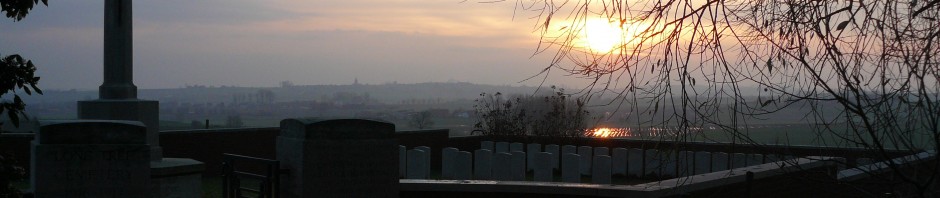

The sun is setting as we arrive at Maple Copse Cemetery at the end of another glorious spring day in Flanders’ fields.

This cemetery has a most curious layout, unique among the cemeteries of Flanders,…

…all of which will be explained shortly. In the meantime, the building on the far left,…

…is our way in.

There are numerous British cemeteries in the Zillebeke area, primarily because the front lines ran close by for so much of the war. This is the furthest east of all the Zillebeke cemeteries, and the only one we have yet to step inside.

Here’s where we are, the cemetery, on the eastern edge of the original Maple Copse (green), marked in pink 1,000 yards east of Zillebeke, Ypres top left, the Menin Road crossing the map towards the top, and the German positions in red on the right, on a composite map from 30th June 1917. The brown shaded area shows the spur known as Observatory Ridge, whose significance will become clear later in this post. You’ll find one of my interactive Google maps at the end of this post showing all the other Zillebeke cemeteries.

The cemetery’s name suggests a Canadian connection, and indeed there are 143 Canadians who are known to be buried here, alongside 113 men from the U.K. and 52 unidentified soldiers, although the nationalities – Canadian or British – of quite a number of these are known.

The ‘In Perpetuity’ tablets can be found inside the entrance building,…

…this the view on entry.

Maple Copse, the trees now slightly further south than during the Great War, was the site of Advanced Dressing Stations with their inevitable burial grounds. The land to the east of Zillebeke was totally devastated by four years of warfare, as this view of Maple Copse and its cemetery shows, and, unsurprisingly, when it came to finding the bodies of the men buried here, only a few, including the graves above, almost certainly today to be found in Plot I, could be positively identified. Because of the wartime devastation, the cemetery is today made up primarily of rows of special memorials – 230 in total – to men known to have been buried here, although exactly where within the cemetery is unknown, their bodies lost long ago. Of the 308 men remembered here in total, by name or unidentified, the actual burial sites of only twenty six are known.
 It would seem sensible to once again present the cemetery plan here within the post (although clicking here will, as usual, open the plan in a separate browser, should you wish) because of its unusual layout. The rows of special memorials, as they mark no actual (discovered) graves, have been laid out alphabetically, for the most part, but more of that shortly. We begin our tour in the bottom left with Plot II Row E, adjacent to the entrance building,…

…where, of the thirteen burials in the row, all but one Canadian private are unidentified.

And these are neither original burials nor special memorials (if you enlarge this shot, the Cross of Sacrifice in Sanctuary Wood Cemetery is visible on the horizon, just to the right of the foreground trees).

The graves in Plot II Row E are all officially concentration burials, if only moved from elsewhere within this cemetery. In 1928, apparently. By which time their bodies had been lying here, undiscovered along the northern boundary, according to the above form, until, for reason or reasons unknown, they came to light. We shall encounter the first four rows of Plot II at the end of the tour,…

…but with Plot II Row E now behind the tree on the right, Special Memorials Row J is the first row of special memorials on this, the southern side of the cemetery, and the burials in the row are all men whose names begin with either an A, a B or a C.,…

…explaining the red lettering, added, by me, to the cemetery plan.

The headstones of Row J, now on the right, and the next row, Row G, on the left, face each other (above & below),…


…the men remembered on the headstones in Row G…

…all men whose names begin with C, D or E.

Canadian memorials at the end of Row G. Beyond the tree,…

…Row E, with the trees of the present-day Maple Copse in the background,…

…and towards the middle of the row, one of those tug-at-yer-heartstrings mementos left at the base of the headstone that remembers Private Everett Fitzgerald, P.P.C.L.I., who died on 11th May 1916.

Aw.

The names of the men remembered in Row E all begin with the letters E, F, G & H, and include a private of The Loyal North Lancashire Regiment who died on 17th June 1915, the earliest known date of death among the men remembered here.

Row C faces Row E (you’d have to ask Baldrick exactly why he appears to be head-butting a tree on the far left),…

…and contains headstones remembering men whose names begin with either H, I, J, K or L.

Looking due east, Row C in the foreground, Sanctuary Wood in the background. In the summer of 1916 the Germans had pushed their front lines to the near edge of the wood,…

…as they sought to take the slightly higher ground of Observatory Ridge, seen here through the trees on the horizon.

It seems extraordinary today that such a small spur of land as Observatory Ridge, seen here from Maple Copse, hardly higher than the fields surrounding it, stretching from east to west through the British lines, as shown on the earlier map, should prove so pivotal. But the capture of Observatory Ridge would allow the Germans to fire into the rear of the British lines for some distance north, necessitating almost certain withdrawal on the part of the British, and quite possibly the total evacuation of the Ypres Salient. More on which later.

The names of the men remembered on the headstones in Row A, the final row of special memorials on the southern side of the cemetery, all begin with either M, at this end,…

…and L at the far end. The individual headstones beyond the Cross are among the few known burial sites here, as is the single grave close to the end of Row A,…

…the second of only two graves in Plot I Row E (the first of which we’ll encounter later), that of Corporal George Goodwillie, 43rd Bn. Canadian Infantry, who died on 11th August 1916.

Cross of Sacrifice.

Beyond the Cross on the right, the scattered individual headstones, all marking actual graves, are the first four rows of Plot I,…

…as listed on this GRRF,…

…and are, most likely, those shown in the earlier black & white photo. What appears to be a single headstone, furthest right in this shot,…

…is actually the two headstones of Plot I Row A. Privates Thomas Leonard Blake & Peter Wilson, 43rd Bn. Canadian Infantry, aged 27 & 33 respectively, were both killed in action on 21st May 1916.

The single headstone behind is the only one in Plot I Row C, with the first three headstones of Row D next in line,…

…and marks the grave of Company Serjeant Major John Roderick Morrison, also 43rd Bn. Canadian Infantry, who died the following day, 22nd May 1916.

The battalion war diary for 21st to 23rd May lists four men killed on 22nd May, and there is one other 43rd Bn. man killed that day remembered among the special memorials here in Row J,

Plot I Row B also contains just a single burial, Lieutenant Gordon Stanley Fife, Princess Patricia’s Canadian Light Infantry, who died on 2nd June 1916, aged 27. And 2nd June, and the days following, would prove to be significant in the fortunes of the Canadian Corps in Flanders. The Canadians had seen their fare share of action, and losses, at the Battle of St. Eloi, two and a half miles to the south west of here, in April 1916, following which there would be recriminations, reorganisation, and changes in command at the very top.

While all this was going on, at the beginning of June 1916, as this map shows, the Canadians were holding the trenches at the most easterly point of the Ypres Salient, from Hooge, just off the map to the north, to Mount Sorrel (shaded in orange), a similar distance to the south, the only remaining high ground still in British hands in the salient. On the morning of 2nd June, the Germans unleashed a furious bombardment on the Canadians, presaging an infantry attack that overwhelmed the Canadian defences, capturing Mount Sorrel (photo below) and Hill 61 (shaded in blue above), effectively, had they realized, opening the way to Ypres. However, after advancing a thousand yards or so, the Germans proceeded to dig in, as were their orders, no enterprising officer on the scene taking matters into his own hands and pushing further forward. The history of warfare is littered with ‘what ifs’.

Hastily reorganised, the Canadians launched a counterattack in the early hours of 3rd June, which succeeded in plugging a six hundred yard gap in the Canadian lines that the Germans had failed to exploit, and, despite heavy losses, advancing the front lines a thousand yards from the position to which they had retreated the previous day. Following further attacks and counterattacks over the next ten days, including the detonation, by the Germans, of four mines beneath the Canadian lines at Hooge, the Canadians managed to retake most of their lost positions, although the trenches at Hooge, lost after the mine explosions, remained in German hands. Canadian casualties between 2nd & 14th June 1916 amounted to around 8,500 killed, missing or wounded, with the Germans suffering a similar amount, perhaps slightly fewer. And in a fortnight, all this would be forgotten, until the historians took over, as they do, in later years, as the little matter of a fracas down on the Somme took hold of everyone’s attention.

Adjacent to the Cross, the fourth and final headstone in Plot I Row D marks the grave of Serjeant John Milton, another 43rd Bn. man, who died on 1st August 1916 aged 26,…

…his death mentioned, if not by name, in the battalion war diary.

The first three burials in Row D are also all Canadian casualties, these men killed in May 1915. Behind, the first row of memorials on the cemetery’s northern side,…

…Special Memorials Row B,…

…are all headstones remembering men whose names begin with M, N, P & R. On the left, the single headstone just in front of Row B…

…is the first of the two burials in Plot I Row E, the other of which we encountered earlier; Private Thomas Wallace, 49th Bn. Canadian Infantry, died on 29th May 1916, aged 22.

Behind the special memorials of Row B, five scattered headstones mark the five original burials of Row F, the first of which is Lance Corporal Edgar Charles Drury, 4th Canadian Mounted Rifles, who was killed in action on 1st April 1916 aged 26.

The second burial in Row F is that of Sapper R. Templeton, Royal Engineers, who died on 14th July 1917.

The remaining three headstones in the row mark the graves of unknown Canadians, two inscribed with ‘A Soldier of the Great War – A Canadian Regiment’, and one…

…with simply ‘A Canadian Soldier of the Great War’. What the difference is, beats me.

With four of the headstones of Plot I Row F beyond, the first headstones in Special Memorials Row D continue the men whose names begin with an R…

…but most begin with the letter S. The single headstone close to the tree in the background…

…is another of the original burials in Plot I, and the only burial in Row G; Private A. Morrison, Northumberland Fusiliers, died on 13th March 1916.

South westerly view looking back along Special Memorials Row D.

Facing Row D, the names of the men remembered on the special memorials in Row F begin, at this end, with the letter T,…

…continue with two men whose names begin with U & V (far left), after which the remaining headstones…

…are all men whose names begin with a W.

Looking west, Special Memorials Row F now the first of the rows beyond the tree, and the remaining three individual graves of Plot I on the right. Plot I Row H comprises the two single headstones furthest from the camera,…

…one of whom, on the right, marks the grave of a totally unknown soldier; the other, on the left, is the grave of Private Edward Ronaghan, Highland Light Infantry, who was killed in action on 8th December 1915, aged 37.

The final burial in Plot I is that of Private Benjamin Platt, East Yorkshire Regiment, who died on 26th November 1915, the single burial in Row J.

Looking south across the cemetery, Special Memorials Row H on the right, Observatory Ridge beyond the modern Maple Copse in the background.

The first three headstones in Special Memorials Row H, here on the left, complete the first letter alphabetical sequence – Wellwood, Warboy & Young – but the remaining headstones…

…no longer follow the sequence we have followed so far. Although the next ten headstones, all Canadian, one killed on 31st March 1916, the others in April, are indeed remembered alphabetically (left above), P first, then K & F,…

…then D to A, they clearly do not follow the earlier sequence,…

…and the remaining dozen headstones, all remembering Scottish casualties from late 1915, Royal Scots & Cameronians (see the second of the GRRFs we just looked at), are randomly placed, alphabetically.

Looking due west down the cemetery, Row H the long row ahead of us, and on the left,…

…the final row of special memorials, Row K, which contains just six headstones, all Canadian, five of whom died in April, and one in May 1916 . Private Richardson, remembered on the headstone on the left, is ‘Buried elsewhere in this cemetery’, whereas the other five headstones are all ‘Known to be buried in this cemetery’, if you can explain the difference? You might also note the slight differences in design between Private Richardson’s headstone and the five alongside. The headstones in the left background next to the cemetery entrance…

…are the first four rows of Plot II, the final row of which we visited at the start of the post.

Of the forty six burials on this side of the entrance building, and these are indeed burials, only ten are identified,…

…two British and eight Canadians, although a number of regiments or nationalities of the unidentified men are known.

These men are all concentration burials, and not from elsewhere within this cemetery, either. These men were disinterred from Ypres Reservoir North Cemetery* and reburied here, for some quite inexplicable reason, bearing in mind the state of this place, and the number of undiscovered bodies still here. This is also where I have to take issue with part of the information you might glean about this cemetery on the CWGC website, which states ‘The cemetery now contains 308 burials and commemorations of the First World War. Of the 78 burials that could be located, only 26 are identified……’. Well, as we know that thirty six of the unidentified men now buried here were once to be found in Ypres, before being moved here later, the true facts are that only 42 burials were actually found here, 26 of whom are indeed identified, and sixteen of whom remain unknown.
*There was once a Middle, and a South cemetery, too. Today, of course, there is just Ypres Reservoir Cemetery.

The first row contains the fifteen headstones of Row C (above & previous), with the thirteen headstones of Row D continuing the row on the left after the gap.

The men reburied in Row D, barring one, are all unidentified,…

…despite regimental emblems on most of these headstones.

A number of identified men can be found in Row A,…

…and if you didn’t study the previous Concentration of Graves Burial Return forms, as you can see from this example for Row A, the ‘means of identification’ column lists exactly that.

Row B, just three headstones, two unidentified men, one Canadian (52nd Bn.), one a Northumberland Fusilier, on either side of an identified 52nd Bn. private who died in May 1916.

Final look across the cemetery towards the modern Maple Copse, obscuring Observatory Ridge beyond (above & below),…


…before we return to the entrance to depart.

The Germans would eventually take Observatory Ridge, Maple Copse & Zillebeke, as they made their final attempt to capture Ypres in the spring of 1918. This map, dated 15th May 1918, German positions in red, British in blue & Maple Copse Cemetery in pink, shows how close they got.
This bespoke Google map details our adventures in Zillebeke over the years, with Maple Copse Cemetery now added (furthest right). Click on any of the locations to open a link to each place of interest. You’ll find similar maps for the other tours featured on this website by clicking the ‘Interactive Tour Maps’ link under the banner heading on each page. There’s also a memorial nearby, although not marked on this particular map, to the Canadian troops who fought in the area between Hooge & St. Eloi between April and August 1916, that we visited one snowy day, many moons ago now, that you can take a look at by clicking here. There’s some nice views in it! Unless you were a soldier huddled in a trench with no view of anything at all.
Thank you M for this very detailed explanation of how the cemetery came about, helps me to understand when I visit the battlefields, the seemingly randomness way some of the cemetery’s are laid out. We only see them now peaceful and calm, post war I can only begin to imagine the difficulty of the job they had.
Thank you M. This cemetery, in particular, must have been horrendous to work in.
In May of 2016 I visited this Cemetery to pay homage to Pte. Nutter, 5th CMR who is commemorated in Row E, plot 9. Pte. Nutter was a relative of my good friend Jonathan Kierstead from Quispamsis, New Brunswick, Canada.
We will remember.
Indeed we shall. Thanks Rick.