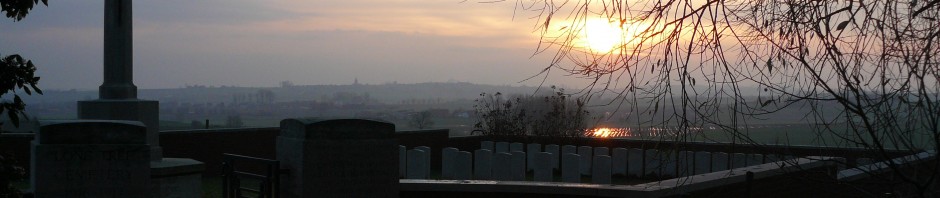

Some years back now, we paid a surprise visit to White House Cemetery, only half a mile north east of the Menin Gate in Ypres (Ieper), on a somewhat greyer day than this one. Surprise, because one minute before we arrived, I had no idea we were going to stop here, and thus had done no research on the place beforehand.

So I also had no idea that, among the almost 1,200 British soldiers buried in this cemetery, there are the graves of four men who were executed, shot at dawn, and one recipient of the Victoria Cross.

Along with, as ever, a couple of other interesting headstones I snapped as I returned this year to look for them.
 The cemetery plan shows us a cemetery of two distinct halves, the western half consisting of both burials made during the war along with some post-war reinterments, and the eastern half consisting entirely of concentrations, hence the regimented nature of Plot III on the right. And although two of the five men we are looking for are buried in the western half, all five are concentration burials, men once buried elsewhere moved here later. The five headstones are marked by the red & blue dots; the other three dots and the mauve oblong are headstones I noticed and photographed on the way.

Just beyond the Stone of Remembrance, immediately on entering, at the start of the first row encountered, and marked on the plan by a light green dot,…

…this is the grave of Lieutenant Colonel Henry William Ernest Hitchins, Manchester Regiment, shot through the heart and killed whilst crossing the ground between the French and British trenches on the evening of 26th April 1915 during the Second Battle of Ypres, aged 49. Initially buried close to where he fell, in April 1919 his body was exhumed and re-buried here.

Only promoted to lieutenant colonel shortly before his death, his second Mentioned in Despatches ‘for gallant and distinguished service in the field’ was for his actions on the day he died.

Grave of an unknown British captain,…

…and, some rows further back, next to two Australian casualties on the left,…

…the graves of two 1st Bn. East Kent Regiment privates, Robert Gawler (left), aged 29, & Alfred Edward Eveleigh (right), aged 27, both executed for desertion on the same day. You might assume that they deserted together, but this was not the case, despite serving together in the same company. Their trials were held separately, although just three days apart. Both had previous convictions for desertion – Eveleigh was already under a suspended sentence of death after an earlier conviction for desertion, and Gawler had now deserted for a third time – and both were executed on the morning of 24th February 1916 at Burgomaster Farm near Poperinghe and buried close to where they were shot. Their bodies were exhumed and reinterred here at White House after the war.

The third of the executed men now buried in Plot III, Private Herbert H. Chase, Lancashire Fusiliers, was executed for cowardice on 12th June 1915. The fact that he had previous – he had been found guilty of absenting himself without leave on 28th August 1914 when on active service, and of escaping while under arrest on 18th October 1914, for which he received a sentence of three years, later commuted to two, penal servitude – certainly went against him at his later field general court-martial. Released after just six months on 6th May 1915, he was soon arrested once again for ‘misbehaving before the enemy in such a manner as to show cowardice’, found guilty at his subsequent court martial, and executed at 4.30 a.m. on the 12th June 1915 at St. Sixtus Monastery near Dozinghem, west of Poperinghe, and buried nearby, his body exhumed post-war and reinterred here. He was 21 years old, and one of only eighteen men to face execution for cowardice during the war.

Across the cemetery, in Plot II,…

…lies the body of the fourth executed man buried here. 24-year old Private William J. Turpie, East Surrey Regiment, deserted on 16th April 1915 and actually made his way back to Blighty before being arrested. Returned to his battalion in Flanders for court martial, he was found guilty of desertion and executed on 1st July 1915. Originally buried near Dickebusch, his body was later exhumed and reburied here.

The single blue dot on the cemetery plan marks the grave of Private Robert Morrow V.C., Royal Irish Fusiliers, who died on 26th April 1915, aged 24. His citation, published in the London Gazette on 22nd May 1915, reads ‘For most conspicuous bravery near Messines on 12th April, 1915, when he rescued and carried successively to places of comparative safety, several men who had been buried in the debris of trenches wrecked by shell fire. Private Morrow carried out this gallant work on his own initiative and under very heavy fire from the enemy.’

Morrow would not live to read his citation. Severely wounded just a fortnight later on 25th April while performing similar heroics during an attack on St. Julien, two and a half miles to the north east, straight up the road from here, he would die the following day.

He must have been swiftly evacuated once wounded, because this Concentration of Graves form gives his (and others now buried here in Row A) original grave site as being in south east Poperinghe, some ten miles behind St. Julien and the front lines.


You may have noticed on the cemetery plan that a large number of special memorial headstones are placed along the western cemetery boundary,…

…for reasons explained on this Duhallow block (click to enlarge),…

…and, looking back down the first sixteen headstones, one in particular stands out, marked by an orange dot on the cemetery plan.

Private Telesphare Roy, 26th Bn. Canadian Infantry, who died on 3rd May 1916 aged 23, was one of a number of men buried in North Bank Military Cemetery, Voormezeele, whose bodies were later lost and who are now remembered individually here.

View looking across Plots I & II towards the Cross of Sacrifice, Plot III in the right background.

There are more special memorials along the cemetery’s southern boundary, in front of which the burials in Plot I Row K are all original burials,…

…although when I last visited, one of the headstones at the start of the row, close to the cemetery entrance, had been temporarily removed for renovation, as the photo I took at the time on the left shows. Here’s a comparison for you, a decade or so between the two photos, their position marked in mauve on the cemetery plan.

And finally, in the cemetery’s southern corner, I spotted the grave of Private Harry Wharton, King’s Own Yorkshire Light Infantry, killed in action on 26th June 1916 aged just 16, his grave site marked by the dark green dot on the cemetery plan. Incidentally, by this time in the war, under-age soldiers were no longer being sent home to their parents as a matter of course; at one stage, a camp at Etaples housed over a thousand boys who had lied about their age on enlistment, many already hardened in battle, some boasting medals, on the basis that on reaching the correct age they could be returned to their units.

The original tour around this cemetery can be found here.

Privates Morrow (left) & Gawler; two sides of the same coin. Incidentally, Putowski & Sykes tome ‘Shot at Dawn’ suggests Gawler was 20, not 29, and I would not be at all surprised.
Thank you as always. A sobering systt to my dsy but good to visit Flanders fields online as in person not an option
I am sorry to hear that but I’ve put Baldrick on the alert just in case things get better. Thanks Morag.
Hi M great report some interesting finds, thanks again for a fascinating report
Thank you M. Always.