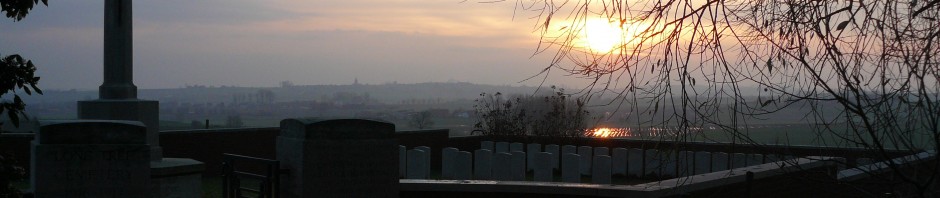

If you were a crow, perched atop the Cloth Hall in the centre of Ieper (Ypres), and you were considering a morning constitutional, it would take you a little over two minutes to make the journey, at cruising speed, down here to Belgian Battery Corner Cemetery.

At the time just a road junction in the fields a mile south west of Ypres, and marked in red on this map dated 30th June 1917, today we are, quite literally, at the south westernmost point of the modern-day city. So why it has taken me over twenty years of exploring Flanders’ fields to finally get here is as much a mystery to me as it is to you. The corner is still here, fifty yards south of the cemetery,…

…although Belgian Battery Bend Cemetery might be a more alliterative, and more accurate, title. Once upon a time, in 1915, this was the site of three batteries of Belgian artillery, but the cemetery is a 1917 cemetery, the majority of the burials, around 450 out of a total of 573, made between June 1917 and the end of the year, the remainder in 1918. It’s an unusual name for a British cemetery, you might consider, but the fact that Belgian Battery Corner is a named feature on the map explains it.

Anyway, I finally made it here, and I rather like this place, although from here it looks as if we have nothing more than a mass of headstones in a field, but the cemetery is far more structured than that, as we’ll see. Beforehand, on the left of this shot,…

…the ‘In Perpetuity’ tablets are inlaid in the exterior wall,…

…with the cemetery name inscribed,…

…along with the cemetery’s dates of use, on either side of the entrance, and the Stone of Remembrance (below) just beyond.


Now, had I turned around at this point and taken a panoramic shot of the cemetery,…

…rather than this shot with the Stone obscuring the view, I could have shown you, rather than just tell you, that the cemetery has two main plots on either side of a grass corridor leading down to the Cross of Sacrifice that you can see at the southern end,…

…although this shot from a short distance into the cemetery shows what I mean. The unidentified soldier in the right foreground, one of only five unknown men buried here, lies in Plot II, and the headstones on the left are in Plot I. All becomes clear if you take a look at the cemetery plan. The earlier map shows that the only buildings in 1917 were just to the south of the cemetery at the road junction, where the modern houses are in the above photo,…
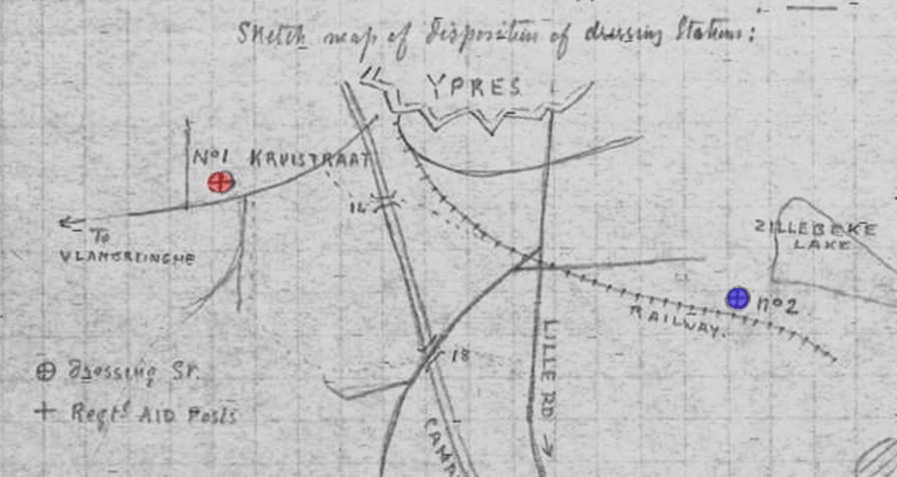
…and this map from August 1915 shows an advanced dressing station, marked in red, already in operation here, staffed, at the time, by two officers and thirty four men ‘with transport’, although where those who died here at that time, and there must have been some, are buried, I do not know. They are certainly not buried here. Were you today to visit the second dressing station on the map, marked in blue, you would find the almost 2,500 men buried in Railway Dugouts Burial Ground (Transport Farm), over 200 of whom are 1915 casualties. But there was never an earlier, second cemetery here, and the closest remaining cemetery is a good 1,000 yards to the north, although straight up the road from Belgian Battery Corner. Divisional Cemetery does contain over 150 burials from 1915, and some from the early months of 1916, so maybe the dead were taken there.

The first, or last, row in Plot I is Row P, left of centre here, shorter than those behind,…

…and including, next to an unidentified man at the start of the row on the right, three special memorials to men ‘Known to be buried in this cemetery’. On the far left…

…this headstone remembers Major Angelo Talbot Hatton, Mentioned in Despatches, Australian Field Artillery, killed in action on 9th November 1917,…

…and once buried, according to the GRRF on the left, at the end of Plot II Row C on the other side of the cemetery (we shall see exactly where later). For some reason the five other men once buried alongside him whose names have been crossed out on the GRRF are not remembered here by special memorials, their names now to be found instead on the Menin Gate Memorial. The modern GRRF on the right lists the four headstones, including the three special memorials, at the end of Row P.

Row P is interrupted by this tree, on the near side of which…

…the final three headstones in the row are all Durham Light Infantry privates killed on 21st May 1918, among the later burials to be found here.

But the majority of the burials were made between June & December 1917, which makes this, primarily, a Passchendaele cemetery, and almost half are artillery casualties, or men attached to artillery units. Plot I Row O (above) contains seven British artillerymen and eight Australians (four artillerymen & four engineers), casualties from September, October & November 1917.

Two Canadian sappers, both Canadian Railway Troops, killed on 15th September 1917, near the start of Row N,…

…and, as we move along the row, four men of the New Zealand Rifle Brigade, all killed on 28th September,…

…and four R.G.A. men, a corporal who died in October on the left, alongside three gunners killed on 14th September 1917.

Looking back across Rows N, O & P towards the Stone and the cemetery entrance.

The graves in Row M are all slightly earlier, men killed in the early weeks of the Battle of Passchendaele. These men are Cameronians (Scottish Rifles), mid-August 1917 casualties,…

…as are the two privates seen here on the left. On the right,…

…the grave of Sapper A. E. Chinnery, Royal Engineers, who died on 5th August aged 32.

Two South Wales Borderers, both privates and both early August casualties, in Row M, and behind, in Row L,…

…four Royal Welch Fusiliers, again all privates, who died on 26th August 1917; note the Welsh flags left at the base of all four headstones.

Also in Row L, Private Reginald John Sanders, Australian Pioneers, killed in action on 9th September 1917 aged 24,…

…buried next to Private John Burns, Royal Scots Fusiliers, who died on 15th September 1917 aged 19.

Row K, mainly artillery casualties from early August,…

…as are the men buried in Rows J & I.

‘A Scottish Soldier of the Great War – Known unto God’

Bombardier Albert Edward Broome D.C.M., Royal Garrison Artillery, who died on 2nd August 1917, aged 31, and is buried in Row J, . His D.C.M. was gazetted on 30th March 1916 ‘for conspicuous gallantry when repairing telephone lines under heavy shell fire, and in maintaining communications during operations.’

Corporal J. Lyddon, R.G.A., who died on 31st July 1917, one of seven men now buried in Row I killed on that fateful day. A total of thirty one men killed that date are buried here.

The Advanced Dressing Station at Belgian Battery Corner, the red dot fourth from the bottom, by the ‘K’ of Kruisstraat, was just part of the vast evacuation procedure in place by the time of the Battle 0f Passchendaele,…

…this diagram showing the evacuation route to the south of the Poperinghe – Ypres road, leading to the casualty clearing stations at Remy Siding (far left).

Still very much part of the evacuation procedure, this diagram from April 1918 shows two ‘Car loading posts’ (self-explanatory, I think), the one to the south of Ypres at the ADS at Belgian Battery Corner.

There are just two burials in Row H1,…

…one a Royal Engineers second lieutenant killed in action on 9th November 1917, the other a Duke of Wellington’s Regiment (second) lieutenant who died in February 1918.

Private I. Addis, Lancashire Fusiliers, another who died on 31st July 1917, aged 19,…

…and six more Lancashire Fusiliers in Row H, among sixteen buried in the row, all killed on 31st July.

The 11th Bn. Lancashire Fusiliers war diary mentions a German shell killing two officers and fifteen men, with another fifteen wounded; ‘Just as Bn. had reached billets [in Ypres] one heavy shell dropped among a platoon of C Coy……’. Both the named officers are also among the Lancashire Fusiliers buried here in Row H.

The first few burials at the start of Row H are the only men other than Lancashire Fusiliers in the row,…

…and the eagle-eyed among you may notice that both the first two headstones have, for some reason, the plot & row inscribed on their edges, whereas normally only the first and last headstones in a row would be so inscribed…

…although there appears to be no reason for this, other than error, as both men’s names appear here, this GRRF extract dated 1920.

Both men also died on 31st July 1917,…

…as did these four men of the R.G.A. at the start of Row F. The Durham Light Infantry bugler on the right is a slightly earlier burial,…

…as are these South Lancashire Regiment casualties further along the row. From here, the remaining burials in Plot I are all from the weeks leading up to the battle.

Looking roughly south west across the final four headstones of Plot I Row F in the foreground, Plot II in the background.

Artillerymen near the start of Row E. Third in line in this shot…

…Gunner James Nicholas Stewart, R.G.A., was killed in action on 12th July 1917, aged 31, his image, presuming that was what the frames contained, sadly now long gone.

Plot I Rows D & C,…

…among the burials in Row D three Royal Engineers killed on 7th & 8th July, and a Worcestershire Regiment private who died on 5th July.

The man buried in the first grave in Plot I Row C…

…is Serjeant Oliver Victor Poulton D.C.M., Royal Engineers, who died on 28th June 1917 aged 30. He was awarded the D.C.M. when a corporal, ‘for conspicuous gallantry on the 18th December 1914, when engaged with a party of men cutting the enemy’s wires, he lay on the parapet of a German trench for one hour shooting at every head that appeared. Corporal Poulton subsequently assisted in rescuing a wounded comrade under fire.’

The majority of the men buried in the row, however,…

…died between 2nd & 4th July 1917. The newish headstone second from the left of Private A. Crane…

…is one of seven South Wales Borderers in the row,…

…all of whom died on 4th July,…

…and all of whom are mentioned by name in the 6th Bn. South Wales Borderers war diary, six killed in action, Private Crane dying of wounds later in the day.

Towards the end of Row C, the grave of Lance Serjeant A. Stephens M.M., Cheshire Regiment, who died on 17th July 1917.

The final, and latest, grave of only thirteen burials, all from June and the first half of July, in Row B, Corporal T. W. Harland, Durham Light Infantry, died on 15th July 1917.

Plot I Row A, the burials also from the second half of June and the first half of July,…

…including five men of the Devonshire Regiment, all killed on 21st June 1917,…
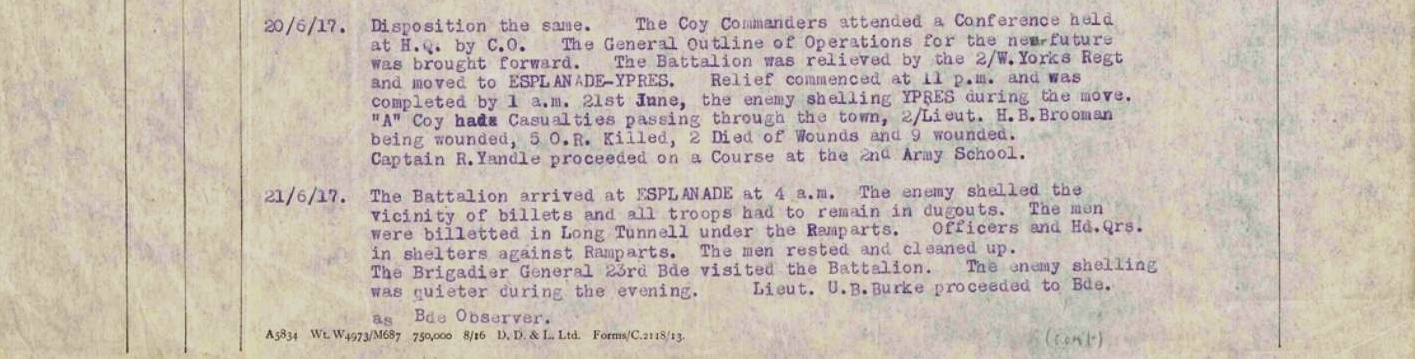
…or more probably the day before, by the looks of the 2nd Bn. Devonshires’ war diary.

Before we move on to Plot II, the R.F.A. subaltern on the right the first burial in the plot, we shall visit the graves of Plot III behind the Cross,…

…six of which are summer 1917 casualties, the rest men who died between June & October 1918.

The longest row, Row B, includes the final burials made here during the war, the last two men buried in the row on the left,…

…both killed in October 1918,…

…alongside a third October casualty on the left, before the late-September 1918 burials begin. We’ll look more closely at what appears to be a more recent replacement headstone in the centre shortly, but first, on the far right,…

…the grave of Company Serjeant Major Daniel Patrick O’Hea, M.M. & Bar, Highland Light Infantry, who died of wounds on 30th September 1918 aged 26.

The central headstone marks the grave of Company Serjeant Major Andrew Gale, The Queen’s, who died on 28th September 1918 aged 41, with a personal inscription that is rather curious; ‘Beloved Gale’ seems an unusual term for a relative to use. Which intrigued me.

A little research showed that, for almost a hundred years, this was the grave of an unknown company serjeant major of the Queen’s, given a date of death of 29th September 1918 on the GRRF on the left,…

…while the name of the man now confirmed to be buried here was to be found on Panel 15 of the Tyne Cot Memorial, as listed on the first column of the Panel List document, from 1926, on the left. And, indeed, still is, the photo on the right taken this year.

However, in 2013, a modern GRRF confirms that it had been accepted that this is indeed the grave of Company Serjeant Major Andrew Gale, and I doff my hat to whoever did the research that has allowed another unknown soldier to reclaim his name.

The row continues with six more late September casualties, five of whom, if you refer back to the GRRF, are buried in a single grave; there was once an unknown American soldier buried to the right of this group, his body long since removed.

Three Argyll & Sutherland Highlander privates who died in mid-July 1918 in front of the Cross of Sacrifice – the reverse of the Cross, of course, with no sword. Personally, I think Blomfield* missed a trick here, because in cemeteries laid out with the Cross placed within the plots of burials, as opposed to at one end or side of the cemetery, would not a sword on both sides of the Cross be, well, better?
*Sir Reginald Blomfield, who designed the Cross of Sacrifice.

Anyway, he chose not to, or he never considered it in the first place. And I do like his steps!

On the left, two Worcestershire Regiment men, a serjeant and a lance corporal, with three military medals between them, both attached to the 100th Trench Mortar Battery, both of whom died on 24th June 1918, and on the right, a Cameronians (Scottish Rifles) private,…

…and two serjeants from the Cameronians, all three of whom died the previous day, 23rd June. On the right,…

…an underage Argyll & Sutherland Highlander, Private Norman Graham Walker, just seventeen when he died on 18th June,…

…alongside another (left) who died on the same day, and who made it to twenty. The machine gunner on the right died on 6th June,…

…the remaining burials in the row between 8th & 10th June. Two of the three King’s Royal Rifle Corps casualties seen here were also attached to the 100th Trench Mortar Battery.

The cemetery’s earliest burials are to be found in Plot III Row A,…

…with the first burials in the row British casualties from June 1917, including, on the left, a Royal Sussex Regiment private who died of wounds on 7th June, the first day of the Battle of Messines,…

…one of two men in the row who died on that date.

Eighteen year old Private Fred Mees, 42nd Bn. Canadian Infantry, who died on 28th March 1916 and is one of only seven Canadian burials here, was the first man buried in this cemetery, although at the time, as we know, this was no cemetery,…

…just a lonely roadside burial,…

…or perhaps a trio of graves, the GRRF revealing, alongside Private Mees’s grave, ‘Two French Graves Removed – Vacant Grave’. I would think these French casualties died earlier in the war, Private Mees later being buried alongside.

The removed French graves explain the gap seen today towards the far end of the row…

…before the final two headstones,…

…on the left, Trumpeter Arnold Robinson, R.F.A., who died on 9th July 1917 aged 23, and on the right, Private R. Lockhead, Machine Gun Corps (Infantry), who died on the previous day, 8th July, aged 33.

And finally, before we leave Plot III,…

…there’s a row of five headstones, Row C, that you’ve probably realized at this point that I failed to photograph,…

…but this GRRF extract at least details the men buried in the row.

Plot II Row A contains some of the earliest Australian burials here.

Captain William George Harvey M.C., Australian Pioneers, was killed in action on 14th September 1917, aged 25,…

…and Lieutenant Colonel Cecil Robert Arthur Pye D.S.O., 19th Bn. Australian Infantry, was killed in action on 4th October 1917 aged 27,…

…and is pictured here, his headstone second from the front, as we look back along the row.

Further along Row A, the grave of Bombardier Isaac Henry Burnham M.M. & Bar, R.F.A., who died on 30th October 1917, aged 27,…

…and towards the end of Row A, a fourth special memorial* in this cemetery, this grave ‘Believed to be’ Gunner William Clarkson, A.F.A., killed in action on 20th October 1917.
*The official CWGC text from their website says ‘…and special memorials commemorate three casualties known to have been buried in the cemetery, but whose graves could not be located.’ But we know there are four.

Panoramic shot looking north east across Plot II, Row A on the far right,…

…at the end of which is a nice little building to shelter from the elements, should you need to do so.

October 1917 burials in Row B,…

…and the grave of Lance Corporal John Henry Sandy M.M., Australian Army Medical Corps, killed in action on 20th September 1917 aged 21.

With Row B just visible on the very far right,…

…these shots show the space at the end of Row C where,…

…as we discovered near the start of this post, more men were once known to be buried. This is also true of Row D, in the centre,…

…for the same reason, this GRRF listing the names of men once buried in Row D whose names are now to be found on the Menin Gate.

These are the men whose graves now end Row C, all Australian artillerymen killed in late October or early November 1917,…

…and further down the row, the grave of Private Charles Gapes, Australian Pioneers, killed in action on 20th September 1917 aged 20,…

…with another Australian pioneer at the start of the row killed in late September 1917,…

…and another here in Row D. Private Ernest Alfred Hall, Australian Pioneers, was killed in action on 4th October 1917 aged 22. I doubt the CWGC will allow the attached, generic, I think, photograph to remain for too long strapped to his headstone, although the pink stone at the headstone’s base, which appears to have been here a while,…

…one of the 600,000 individual sculptures representing all those who died in Flanders during the Great War that made up the ‘ComingWorldRememberMe’ art installation once displayed near Zillebeke, which I visited on Armistice Day 2018, and which you can take a look at here, if you are intrigued, will hopefully remain.

Still in Row D, the grave of Captain Douglas Gordon Campbell, Australian Field Artillery, killed in action on 21st October 1917.

Row E, among the casualties…

…these three Australian infantry privates, one of whom served under an alias, all killed in action on 25th October 1917.

The first grave in Row E is that of Captain Thomas James Golding, R.A.M.C., killed in action on 20th September 1917, aged 30.

‘An Australian Serjeant of the Great War – Known unto God’

The majority of the burials in Row F are Australian, most of whom died in October 1917. These burials towards the start of Row G are from October & November 1917, and there are some casualties from January 1918 at the other end of the row.

The two headstones on their own at the start of Row H,…

…are also October & November casualties, Australian on the left and British on the right,…

…the row continuing with more Australian infantrymen, eleven in a row,…

…all killed on 27th October 1917.

Row I, this grave that of Private James Bromilow, Machine Gun Corps Infantry), who died on 1st April 1918 aged 21, his headstone devoid of a cross,…

…and more machine gunners, these men all Australian, further along the row, all killed in action during the last week of September 1917,…

…with another on the right here, next to a Manchester Regiment private who died in late January 1918,…

…and still in Row I, the grave of another unknown Australian sergeant. Sergeant, on this occasion, spelled with a ‘g’, not the usual ‘j’.

Row J, the headstone closest to the camera…

…marking the grave of Private G. McLean, West Yorkshire Regiment, who died on 14th May 1918.

April 1918 casualties in Row J, men killed during the Battle of the Lys.

Row K,…

…these men at the end of the row a mix of April & May 1918 casualties,…

…as are these men further down the row.

View looking south east across the cemetery, the men buried closest to the camera in Row L…

…three Norfolk Regiment privates killed on 29th May 1918,…

…all but one of the rest of the casualties in the row also May 1918 casualties.

Row M, the two headstones seen here…

…both men of the Indian Royal Artillery. On the left, Driver Kirpa, who died of wounds on 15th March 1919, and on the right, Lance Naik Dhani Ram, who died the previous day, 14th March 1919. One suspects that an accidental explosion was the cause, killing one and mortally wounding the other.

Two Durham Light Infantry privates in Row M, both given a date of death of 13th September 1918.

The 19th Bn. war diary details the foiling of a German trench raid that day, although no casualties are mentioned. And the battalion was involved in a major operation just two days later.

Two Worcestershire Regiment privates, both nineteen years of age, both killed on 5th May 1918 at the start of Row M.

And finally, Row N, just seven graves, all men killed on 30th May 1918, four of whom are machine gunners,…

…except the final burial on the right, a Durham Light Infantry lance corporal who was killed in action on 15th September 1918, quite possibly during the attack on that day mentioned in the war diary extract we just looked at.

Back at the Stone of Remembrance,…

…and just before we take our leave, the sign you can see…

…informs us of ‘Essential Maintenance Work’ being carried out, although the CWGC website is more specific (the capital letters are theirs); ‘We are currently carrying out some Horticultural Improvements Works in our Cemetery. Part of these improvements is to replace the Boundary Hedge. We plan to remove the Hedge completely from the 14th of July 2025. For this reason, the normal maintenance of hedge cutting in June/July will not be carried out. A new hedge will be planted between November 2025 to March 2026. The soil quality will be improved before the replanting takes place.’

Which presumably refers to this, over on the far side of the cemetery, although as these photographs were taken in late March 2026, I suspect that the deadlines given may have slipped somewhat.

I don’t suppose, despite its proximity to Ieper, that this cemetery is visited often, so if you find yourself nearby, I’d say it’s worth a few minutes of your time.
Thank you MF I must get back to Ieper sometime your posts show me how much I missed last time.
Would you mind if I posted the photo of the 3 Norfolk graves on a Memories of Norfolk Regiment FB I will credit it to you
Of course you can, Alan. Your continued support is much appreciated.
Wasn’t aware of this cemetery. Sterling work as usual
Most kind Peter. Appreciated.
Proficiat
Most kind, Theo. Thank you.
Hello M been to leper a few times but your right never visited that cemetery, so thanks for the info and for helping me understand better what seems so random with the dates etc of the burials, being a concentration cemetery explained a lot. What a terrible job that must have been after the war hard to understand what they went through trying to give these men a decent permanent burial
Hello M. It’s worth a visit; there are three cemeteries – this one, Divisional & Railway Chateau – on the western outskirts of Ieper, and I don’t think they are visited by many people. But all three are now covered on this website. Thanks as ever.