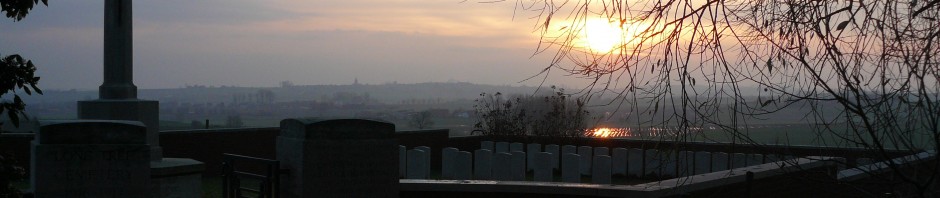

That’s eighteen years since I last set foot in this cemetery, before you ask. And I don’t imagine it’s changed a huge amount, although you never know.

At the time there was no ‘With the British Army in Flanders’ website, nor any thought of such a thing. But within a few years we were up and running, the original New Irish Farm Cemetery post, with photos taken in 2008, published in June 2011 as part of ‘The Road to Passchendaele’ series. To which I have naturally tagged this new post. So as we tour the cemetery,…

…I’ll include a few shots from my first visit such as this one – they’ll be easy to spot, if I forget to mention them, as it was high summer at the time, the trees awash with green, and all the flowers in bloom, as you can see. You might well notice some apparent differences in the surrounding landscape as we continue.

Impressive cemetery entrance,…

…the cemetery name above,…

…and the ‘In Perpetuity’ tablets, in French (left), and English & Flemish (right), inside. But before we go any further,…

…some context. Three cemeteries are to be found today within the shaded rectangle at the top of this map, around a mile beyond the northern outskirts of Ypres (Ieper) as they were in May 1918 (and considerably nearer today), by which time the Germans had come as close to the city as they were ever going to get, their final positions marked in red on the far right of this map. La Belle Alliance Cemetery (bottom inset) was begun in February 1916 and only used for a month until early March, by which time just thirteen identified burials had been made, before being used again in the second half of July and early August 1917, at which time the cemetery, as it does today, contained just sixty burials. Divisional Collecting Post Cemetery (top inset), begun in August 1917, contained eighty six graves at the Armistice, and New Irish Farm Cemetery, also begun in August 1917, contained just seventy three burials.

A total of 219 burials between all three cemeteries, which would have looked something like this at the war’s end, La Belle Alliance in red, Divisional Collecting Post, yet to have its extension added, in mauve, and New Irish Farm on the right in pink,…

…and which looks something like this today, over 5,500 men now to be found buried in these three cemeteries. The actual Irish Farm is marked in green, and earlier in the war there was another small cemetery immediately to its south, which explains why the current cemetery has the prefix ‘New’.

The immediate view on entry of New Irish Farm Cemetery, then (left) & now…

…swathes of headstones to both right,…

…and left,…

…with, directly ahead of us, the slightly raised area on which stands the Stone of Remembrance, and the three rows of headstones that comprise Plot I.

After the war, over 4,500 bodies were brought here from the battlefields to the north-east of Ypres, and from a selection of smaller cemeteries, as we’ll see as we look around.

And we shall begin our exploration with the raised graves of Plot I,…

…as, at the time of the Armistice, these were the only graves here.

Three rows of headstones,…

…the majority casualties from the fighting in August 1917. Row A, here on the left, contains forty two headstones, Row B, on the right, ten,…

……and Row C sixteen, at least as far as the cemetery plan (extract below) is concerned.

The CWGC website tells us that ‘at the Armistice it contained just 73 burials – the three irregular rows of Plot I’, but that seems to differ from the numbers on the plan, because we can all agree that 42+10+16 is 68, but if you count the number of headstones in Row C in the photo on the right*, or take my word for it, there are nineteen, not sixteen, as the cemetery plan suggests. And the reason is straightforward enough.
*taken on my first visit.

The first three burials in Row C…
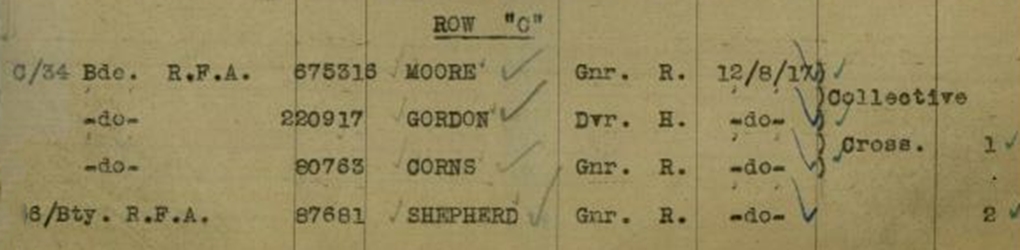
…were once buried beneath a collective cross, and although all now have individual headstones, all are designated as Row C Grave 1,…

…and two men at the end of the row also share the same grave reference as each other, as shown on this GRRF extract. Which accounts for the nineteen burials in the row.

And further back, at the start of Row A, the second headstone reveals three names, all Royal Warwickshire Regiment, as is the first burial in the row, on the left, this headstone supplying the regimental emblem for all four men.

And thus the forty two headstones in the row contain forty four names,…

…except, of course, they don’t, because the row includes three unidentified men, leaving a total of 41 named burials in the row.

There is also an unidentified man among the ten burials in Row B, the seventh headstone in line, closest to the camera here,…

…with the remaining three burials in the row spaced apart a short distance away. So we have sixty nine identified men, and four unidentified, across the three rows, making a total of seventy three burials. On the far right of the front row,…

…Rifleman Benjamin Millar, Royal Irish Rifles, who died on 21st May 1918 aged 24, was the final wartime burial made here, one of only four burials here in Plot I from 1918,…

…his headstone seen again in the left foreground as we look at the Stone of Remembrance as it was some eighteen years ago,…

…and as it looks today. Thirty six of the graves in the plot are those of artillerymen, three R.F.A. men among the six men whose headstones are pictured here, the man on the far right unidentified, yet all six known to be casualties of the mid-August fighting during Third Ypres.

The other three 1918 burials in the plot are to be found at the end of the row,…

…as detailed at the bottom of this GRRF, next to which lie eight men, seven air mechanics and a private, all members of the 39th Balloon Section, an observation unit of the Royal Flying Corps.

3rd Class Air Mechanics George Peel & Samuel Ackroyd,…

…3rd Class Air Mechanics David Urban Parsons & James Alfred Waters, and 1st Class Air Mechanic Herbert E. Ponder,…

…and Private Thomas Myers, 3rd Class Air Mechanic John Thomas Spence & 1st Class Air Mechanic John McAlpin were all killed by German artillery fire on 17th November 1917.

Which leaves us with the rest of the cemetery to look around,…

…and as all the remaining plots are concentrations (now, left, & then, right),…

…it really makes little difference in what order we visit them.

So as there are some steps leading down from Plot I beyond the Stone,…

…two sets of steps, actually (see plan below),…

…we’ll take a brief look around the centre plots (those in red) first, before we consider the rest of the cemetery. On the right, buried in Plot XII Row A, the grave of Company Serjeant Major P. Timoney D.C.M., The Cameronians (Scottish Rifles), who died on 1st August 1917. His D.C.M. was gazetted in May 1917 ‘For conspicuous gallantry and devotion to duty. He rendered invaluable service to his Officer in keeping a raiding party together and leading them forward.’

Unknown burials in Plot XII,…

…Row C now in the foreground,…

…and further back, Plot XVII, looking at Rows E & F.

The only identified German burial here, Grenadier George Lentz died on 4th October 1916 and is buried in Plot XVII Row B. His body was found not so far from where he now lies, in the fields to the west of the present cemetery.

Adjacent to Plot XVII, Plot XVIII,…

…and then Plot XIX,…

…these graves in Row A all unidentified,…

…as we follow the row across the cemetery.
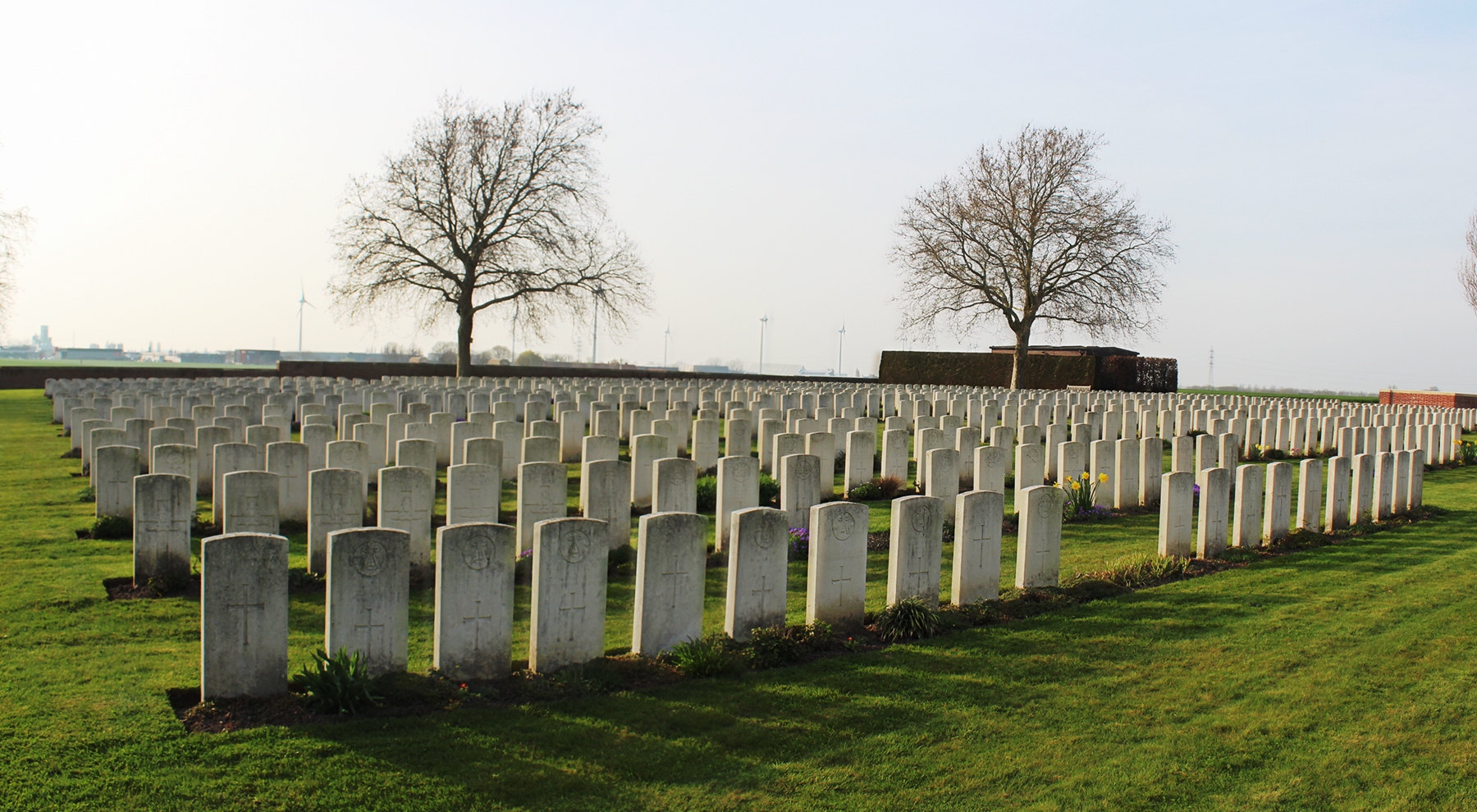
A similar view of Plot X, Row A in the foreground,…

…and now in Plot XI, looking north west across Row C in the foreground. If we turn a little to our right,…

…this view looks between Rows D & E towards the Cross of Sacrifice and the cemetery’s northern boundary…

…where we will find ourselves much later in the post.

In the meantime, we shall head back to the steps leading up to Plot I…

…and the Stone of Remembrance,…

…from where this view looks towards the cemetery’s southern corner, Plot IV closest to us,…

…and shaded in blue here. We’ve already visited the plots shaded in green & red, and we’re now headed for Plot V, in the cemetery’s south eastern corner, and shaded in yellow, from where we’ll tour the rest of the cemetery in a clockwise direction. More or less.

Plot IV in the foreground and Plot V beyond, the church at St. Jean (now St. Jan) on the horizon. The burials furthest from us, beneath the tree in Plot V Row A,…

…include, on the far right, one of only eighteen identified men of the New Zealand Expeditionary Force buried here, alongside four Lancashire Fusiliers, two killed on 17th October & two on 22nd October 1917.

Although not mentioned by name, the 19th Bn. Lancashire Fusiliers war diary records four men killed by artillery fire on 17th October (the other two are also buried side-by-side here in Plot VII),…

…and eight men killed on 22nd (one of whom can be found in Plot VII), the men buried beneath the headstones pictured at the start of Plot V Row A surely among them.

Moving along the front row, an unknown soldier of The Black Watch next to a totally unidentified soldier on the left, and two identified men of the King’s Royal Rifle Corps, a rifleman & a corporal, both of whom were killed on 2nd August 1917,…

…the 17th Bn. King’s Royal Rifle Corps war diary noting the battalion’s casualties between 31st July & 5th August at the bottom of this diary extract. Eight more of the 28 other ranks noted as killed are also buried elsewhere in this cemetery.

If you check the cemetery plan, you will see that the two rows at the front of Plot IV, adjacent to Plot V, are designated as Row BB and, behind, Row AA, at the time containing seven and three burials respectively. Clearly men have been added since, both rows now containing considerably more burials, although just a single man in this shot, towards the right of the front row, is identified. Next to him, on the extreme right,…

…three touching headstones, two unknown British soldiers, one a Royal Fusilier, with an unknown German casualty on the right.

Still in Row BB, three unidentified men, including a Royal Inniskilling Fusilier and a man of the Hampshire Regiment, share a collective grave with a Royal Newfoundland Regiment private killed in action on 16th August 1917, aged just seventeen. Unfortunately there are no documents available for Private John Lambert, but the name of the man buried to the right of the collective grave, Private John Tame, Royal Berkshire Regiment, who died the same day,…

…was once to be found among the almost 35,000 names on the Tyne Cot Memorial (bottom right),…

…and indeed, as I visited earlier this year, still is (again, bottom right).

Behind, in Row AA, four unidentified men of the Essex Regiment alongside two Royal Fusiliers, the headstone on the right marking the grave of two unknown soldiers, one of whom is also known to be a man of the Essex Regiment.

Two Royal Welch Fusiliers, the identified man, Private W. Darch, killed on the opening day of the Battle of Passchendaele, 31st July 1917, towards the end of Plot IV Row B. Across the way, Plot III (below), with the raised headstones of Plot I beyond.


Looking back across Plot IV towards the cemetery entrance – we haven’t got very far yet, have we – Row C on the left,…

…and turning to our left, Plot IV Row D now in the foreground.

Back in Plot V, with another of the identified New Zealanders buried here fourth from the left in Row H…

…as we look along the row towards Plot IV, Plot VI (background left) and Plot I beyond.

Plot V Row J on the right, with the start of Plot VII on the left,…

…Row A continuing here.

An Irish Soldier of the Great War

Plot VII Row F begins with three unidentified men of the Bedfordshire Regiment, and behind,…

…unidentified Canadian infantrymen in Plot XIV Row A, on the left 2nd Bn. & 72nd Bn., and on the right, 16th Bn.

Looking along Plot XIV Row C towards the cemetery’s southern boundary,…

…where a long line of special memorials remember thirty nine men either ‘Known’ or ‘Believed to be buried in this cemetery’.

The documentation associated with these special memorials is not exactly straightforward.

These two GRRF extracts list the names to be found on the first six headstones, if not in the order in which their headstones are today placed (Private Flather’s headstone, for example, is first in line),…

…and the three men listed on this extract – Private Fullbrook, his name crossed out, is indeed buried in Sanctuary Wood Cemetery (as noted in pen, bottom left above) – are the next in line, although again in a different order, Privates Cody & Forde closest to the camera in the previous picture,…

…and Second Lieutenant Croucher on the left here. The row continues…

…with Gunners Taylor & Wilson,…

…and then Corporal Shaw & Gunner Crockford,…

…with Bombardier Wragg & Corporal Inch on the left here, and then Privates O’Connell & Conroy,…

…whose names you will find at the bottom of this GRRF. And continuing the names from the bottom up,…

…Private Cole here on the left,….


…to Private Sunderland, at the top of the GRRF, fourth in line here. The fifth headstone…

…remembers Captain John Francis Cecil Dalmahoy, 40th Pathans, killed in action leading his company on 26th April 1915, during the Second Battle of Ypres, and today ‘Believed to be buried in this cemetery’.

And at this point things turn a little trickier. Captain Dalmahoy’s name is one of only four on this GRRF who are today remembered here on special memorials, the other three, whose headstones follow his, being Corporal Rutter, Private Affleck, and Rifleman Bartlett, the first name on the form. All four are ‘ticked’, which must mean something. Of the other names on this form, all are now to be found on the Menin Gate Memorial to the Missing except for Private Worster,…

…whose name is on the Tyne Cot Memorial. Quite why these men, who in 1923 were all ‘Believed to be buried in this cemetery’, are no longer remembered here, is a question I have no answer to. What’s more,…

…one of the men once believed to be buried here is a Victoria Cross holder. Second Lieutenant Denis George Wyldbore Hewitt, Hampshire Regiment, was just nineteen when he was awarded a posthumous V.C. ‘For most conspicuous bravery and devotion to duty when in command of a company. Having gained his first objective, Second Lieutenant Hewitt reorganised his company and led them forward under very heavy machine-gun fire. Whilst waiting for the barrage to lift, he was hit by a piece of shell, which exploded the signal lights in his haversack, setting fire to his equipment and clothes. Although severely burned and in great pain, he continued to move about and encourage his men. He was then hit by a sniper, but continued to cheer his men on until he was again hit, which resulted in his death. His splendid example of courage and indomitable devotion to duty was the means of carrying the objective.’

A second, earlier, GRRF (left) also lists him as being remembered here at New Irish Farm, but there he is on the Menin Gate panel list on the right,…

…one of eight V.C. holders to be found among the more than 54,500 names on the memorial. S0, in both 1921 & 1923 Hewitt was believed to be buried in this cemetery, and yet by July 1926, prior to the memorial’s unveiling in 1927, his name appears on the Menin Gate panel list. It’s all a bit strange. If you are interested, you’ll find my post about all eight V.C. holders here.

Back among the special memorials that actually are here, Private Affleck & Rifleman Bartlett on the left followed by the final five headstones,…

…Private Atwood the name on the last headstone.

The special memorials are still visible on the left as we look at Plot XIII,…

…and here Plots XV & XX, Plot XIV Row F closest to us on the left.

Two unknown soldiers, one, on the right, a Royal Inniskilling Fusilier, in Plot XV Row A.

A New Zealand Soldier of the Great War

More unidentified men in Plot XV Row B,…

…and now in Plot XVI, looking down towards the western boundary, the identified Lanacashire Fusilier in Row A in the foreground, Private M. Johnston, another killed on the first day of the Battle of Passchendaele, 31st July 1917.

An Officer of the Great War – 55th Division

There are only twenty nine identified Canadians buried here, along with many unidentified.

A Soldier of the Great War – Gloucestershire Regiment

A Soldier of the Great War – Royal Field Artillery

Another unknown Canadian on the left in Plot XX Row A,…

…and the final rows of the same plot in the cemetery’s south western corner,…

…the plot shaded in mauve here. Before we begin to explore the plots along the cemetery’s western boundary towards Plot XXXIV, shaded in brown,…

…if we turn a little to our right, there are more headstones beneath the cemetery wall in the background,…

…and even more further on, as we look from Plot XX in the foreground towards Plot XXI.

These eight headstones…

…mark the graves of seven Chinese Labour Corps casualties,…

…all men who died between April & August 1919.

The eighth grave, in the centre here, is that of ‘A Soldier of the Great War – Unknown Sepoy – Indian Army’. The seven Chinese may have been flu casualties, but the fact that both of the men pictured here, on either side of the sepoy, share the same date of death, 9th June 1919, tends to suggest that at least some of these men are battlefield clearance casualties.

Unfortunately, although all seven Chinese headstones have service numbers, and are thus all identified, for obvious reasons I cannot tell you their names from their headstones,…

…although their translated names are noted on both this GRRF (left) and the more accurate, I suspect, Cemetery Index extract on the right.

Looking back down the length of the southern side of the cemetery, Plot XX in the foreground,…

…and a panoramic shot of the entire cemetery from the western boundary.

Plot XXI in sun,…

…and shade, with Plot XX now on the far left.

Plot XXII. Towards the far end of the front row…

…the grave of Private Henry Morris Wolfsbergen, 1st Bn. London Regiment (Royal Fusiliers), who died on 14th September 1917 aged 19,…

…the only identified man on this GRRF. There were more than a few British-born sons of immigrant German parents who joined the British Army during the Great War, and their story is often a curious one, even if you’ll have to find out for yourselves if you are interested.

More special memorials along the western boundary,…

…this cemetery plan extract showing thirty four memorials, although if you count them today, you will find only thirty,…

…which is also the number on the Duhallow Block that stands in front of the memorial headstones: ‘To the memory of these 30 soldiers of the British Empire who fell in 1914, 1917 and 1918 and were buried at the time in La Miterie German Cemetery, Lomme and Francois Farm Cemetery, Vanheule Farm Cemetery and Spree Farm Cemetery, Langemarck but whose graves were destroyed in later battles’.

Back at the start of the row of memorials, the first group of five headstones remember the men buried in Venheule Farm Cemetery,…

…their names listed at the bottom of this GRRF dated 1923. The first names on the form we have already encountered, among the special memorials along the southern boundary.

These two Seaforth Highlander casualties…

…were buried in Francois Farm Cemetery, Langemarck,…

…and the next nine headstones…

…remember men buried in La Miterie German Cemetery, Lomme,…

…as listed here.

The remaining special memorials…

…fourteen in total,…

…remember men originally buried…

…in Spree Farm Cemetery, Langemarck,…

…their names listed on this GRRF.

Looking south along the row of special memorials and the cemetery’s western boundary,…

…and before we move on, here’s another map. The CWGC website lists seventeen specific British cemeteries from where bodies are known to have been exhumed and reburied here at New Irish Farm after the war, or where men were known to have been buried but whose graves were later lost and are remembered here by these memorials along the western boundary. Sixteen are marked on this map (one is slightly further west), as close as possible to their actual locations as I could work out (not easy with no map references and only old maps to study). The thirteen yellow stars are cemeteries, now long gone, from where the bodies were reinterred here, the three blue stars are the three British cemeteries where the men’s bodies were lost and who are now remembered by these special memorials along the western cemetery boundary, and the seventeenth – the red star with the black centre – marks the position of New Irish Farm Cemetery today. You’ll spot them all if you look carefully (or click the map to enlarge), but don’t be fooled into thinking that these were the only cemeteries in the area covered by this map. Other than the many CWGC cemeteries that today exist in this area, only New Irish Farm marked, there were many other burial grounds from where bodies were later exhumed and reinterred in CWGC cemeteries other than New Irish Farm. I have no idea if the list of cemeteries on the CWGC website with regard to New Irish Farm is complete or not, but the total number of men exhumed and reinterred here from all the cemeteries marked on the map is less than 400, a rather small percentage of the over 4,500 men brought here post-war.

Looking west over the cemetery wall towards the tiny La Belle Alliance Cemetery on the left, and the much larger Divisional Collecting Post Cemetery & Extension on the right; note the different sizes of the Cross of Sacrifice in either cemetery.

Plot XXIII (above & below),…

…looking towards the cemetery’s north western corner, Plot XXIV next in line,…

…among the unknown soldiers in the front row,…

…a man of the Royal Sussex Regiment on the left, and an Argyll & Sutherland Highlander on the right.

On the left, next to two unidentified soldiers in Plot XXIX Row C, the man in the centre known to be from the King’s Liverpool Regiment, Serjeant J. McIntosh, Royal Scots, was killed in action on 29th November 1915 aged 24.

His body was found after the war, along with a number of others (Private Peck is today buried further along the same row),…

…at a location (red dot) very close to Maple Copse Cemetery, where we paid a visit earlier this year.

Looking south down the final rows of Plot XXIX,…

…and likewise north along the final rows of Plot XXXIV, Rows D, E & F.

It’s a big place, isn’t it? View from the cemetery’s north west corner, Plot XXXIV in the foreground,…

…the complete plot shown here.

Among the graves in Plot XXXIV,…

…in the centre of these three casualties, Private H. Death, Grenadier Guards, was killed on 8th November 1914,…

…at a time when 2nd Bn. Grenadier Guards were in action at Klein Zillebeke, south east of Ieper, according to the war diary. Two of the men killed on 7th November are today buried here in Plot XXXII,…

…including Private C. W. George, the first name on this form. Private Death’s name appears further down. You will also notice that the map reference given for all the Grenadier Guards is the same; S28 J25 a26, the area marked on the map extract by the green circle (click to enlarge, of course). The Menin road crosses at the top of the map, about three miles from Ieper to the west, and the trenches marked are by this time all German, the map dated July 1917. I can find no reference that a British cemetery ever existed here prior to post-war consolidation, suggesting that these men were buried where they fell in 1914, quite probably by the Germans over the winter of 1914-1915.

And it may be that the unidentified Grenadier Guard corporal here in the centre is the same man as the unknown corporal listed on the Burial Return form.

Two burials in Plot XXXIII Row B. On the left, Captain Hugh Mortimer Travers D.S.O., Mentioned in Despatches, Royal Munster Fusiliers attd. Duke of Wellington’s Regiment, who died on 8th November 1914 aged 41, and on the right, Lieutenant Colonel J. Falvey Beyts D.S.O., Durham Light Infantry, killed by German shellfire at Hooge on 5th October 1917, aged 29. His D.S.O. was awarded posthumously. And, although obscured by grime in this picture, the personal inscription on his headstone reads ‘Under his leadership his battalion captured Cameron Copse’.

The final name on both the original Burial Return form (left) and the GRRF (right), Lieutenant Colonel Falvey Beyts was buried next to, at the time, an unidentified captain of the Royal Munster Fusiliers. Today, the CWGC website informs us that ‘Recent research has shown that Captain Travers is buried here. Please note that this casualty was previously commemorated on the Ypres (Menin Gate) Memorial; his name will be removed when the appropriate panel is next replaced.’ Although quite what ‘recent’ means, there being no date, who knows?
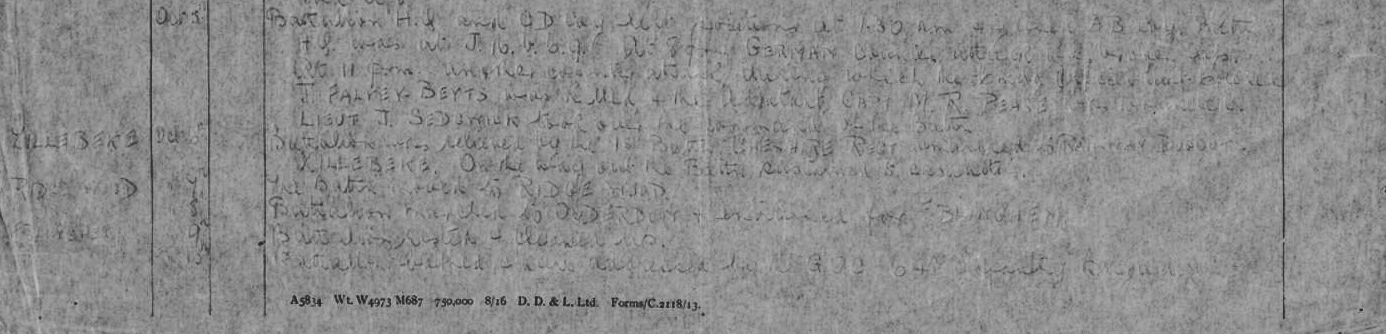
The war diary of the 15th Bn. Durham Light Infantry is difficult to decipher at times, but ‘J. FALVEY BEYTS was killed’ can be seen at the start of the fourth line.

Plot XXXIII Rows D & C, and at the end of the plot, along the northern cemetery boundary, the headstones of Plot XXXVI.

Plot XXXVI consists of two rows of twenty five headstones each, facing the rest of the cemetery to the left of the Cross of Sacrifice (see cemetery plan), the brick surround of which appears on the far right.

The bodies of the men now buried in Plot XXXVI were recovered from the Boesinge battlefields, a mile and a half north west of here, or from the front lines east of Ypres.

Most are, of course, unidentified,…

…although the identities of one or two of the Australians buried in the second row are known, the final name, of just three, on this form, Lance Corporal Joseph Quigley,…

…buried beneath the headstone with the Australian emblem on the left in the back row.

Plot XXVIII, Row B in the foreground,…

…and the same plot, looking the other way, Row A, you might have guessed, now in the front.

Looking north,…

…Plot XXXII Row D on the left and Row C on the right,…

…towards the Cross of Sacrifice,…

…and the view looking back across the cemetery from in front of the Cross.

Still looking at Plot XXXII,…

…Row A in the foreground.

Three unknown Canadians, the man on the right identified as Canadian Scottish, in Plot IX Row C,…

…and three Able Seamen of the Drake Battalion, Royal Naval Division, who were killed on 31st October 1917 fighting as infantrymen, now buried together in Plot IX Row D,…

…their deaths noted in the battalion war diary, as indeed is the original Irish Farm,…

…their identities (eventually) confirmed on this GRRF. Along with more unknown Canadians in the row behind.

Plot XXVI, and beyond,…

…Plot XXXI, at the end of which…

…we arrive at Plot XXXV, in the background, to the right of the Cross of Sacrifice, which, just like Plot XXXVI to the left of the Cross, consists of two rows of twenty five burials each, the headstones facing the rest of the cemetery.

And like Plot XXXVI, these burials include a number of unidentified Australians,…

…as well as eight who are identified,…

…all killed in action in the second half of September 1917.

There are thirty nine identified Australians in total buried in the cemetery,…

…most killed in September 1917, a few earlier, in July 1916. On the far left in the front row,…

…A Canadian soldier of the Great War – Canadian Mounted Rifles

View looking south across the rear of Plot XXXI towards the cemetery entrance, centre right,…

…and now looking back across Plot XXXI, Row A in the foreground (above & below).


The seven largest plots – each has nine rows, all the other plots, except Plot I, seven – are the rows at the cemetery’s eastern end, where we began the clockwise part of this long trek in Plot V on the far side of the cemetery. This is Plot XXX,…

…and these are more Canadian casualties in Row F, the one identified man a 7th Bn. serjeant killed in action in early June 1917.

Looking back across the cemetery from close to its north eastern corner,…

…Plot XXX in front of us,…

…the headstones in the front row, Row A, shown here (above & below).


Plot XXV,…

…and further back in the plot, this shot looks south west towards the two trees and the Stone of Remembrance in Plot I.

Making our way back towards the cemetery entrance,…

…past Plot XXV,…

…and Plot VIII, these same headstones…

…seen here on my first visit.

Unidentified Canadians, two known to be 72nd Bn., in the second section of the front row.

And finally, Plot II, some years back (above) and today (below),…

…where our long, and I hope not unduly tedious, tour ends as we look once again towards the Stone of Remembrance in Plot I. The first four headstones mark the graves of four York & Lancaster Regiment privates, all of whom died on 23rd April 1915, alongside two men of the Royal Irish Rifles, the one on the far right unknown, the other killed in August 1917.

22rd April was, of course, the very start of the Second Battle of Ypres,…

…and the 1st Bn. York & Lancasters found themselves in action near St. Jean, not so far from here, the church spire seen on the horizon in some of the earlier shots.


The bodies of the four York & Lancaster men now buried in Plot II Row A, Privates Copeland, Fenn, Jones & Kent, along with others of the battalion including, at the top of the list, the man in command, Lieutenant Colonel Arthur George Burt, also killed on 23rd April,…

…were all discovered a matter of yards from where they are now buried, somewhere in the fields beyond the two nearby cemeteries we saw earlier.

Burt’s name appears on this casualty list in the war diary a week later, along with other officers killed, missing & wounded, and 58, later increased to 6o, other ranks killed. Lieutenant Colonel Burt is now buried here in Plot IV.

As we take our leave, and if you haven’t seen enough of the place, here’s a link to my original, much shorter, post: New Irish Farm Cemetery.

And if you think this place is big enough, just you wait………
First class as usual. Great info about the Menin Gate as well.