
I’m afraid that I may have misled you slightly with the title of this post. ‘A Question of that Haircut’ would be more accurate, as you’ll see.

Now, I don’t suppose you’ve spent too much time considering the matter of Great War soldiers’ hairstyles. Whether it will surprise you to hear that I have, I know not, but some years back now, Duncan the Younger & I began to notice a particularly curious hairstyle appearing in the occasional photograph of British soldiers. Unfortunately, I didn’t keep copies at the time, and it’s not that easy to find photos that show what I’m on about.

Nevertheless, having your hair cut was one of those necessary tasks that had to be done on a regular basis for various reasons, not least ones of hygiene,…

…and the ever-present lice, the bane of the infantryman’s life.

The introduction of gas masks required a short cut to ensure they fitted properly and were unencumbered by a soldier’s hair, with possibly fatal consequences.

The man doing the cutting here – I hesitate to use the word ‘barber’ in deference to barbers, and in particular any who might read this post – and perhaps his colleague on the right, are sporting a curious cut if you look carefully,…

…seen again here modeled by the three-legged man in the centre, and the man on the far right,…
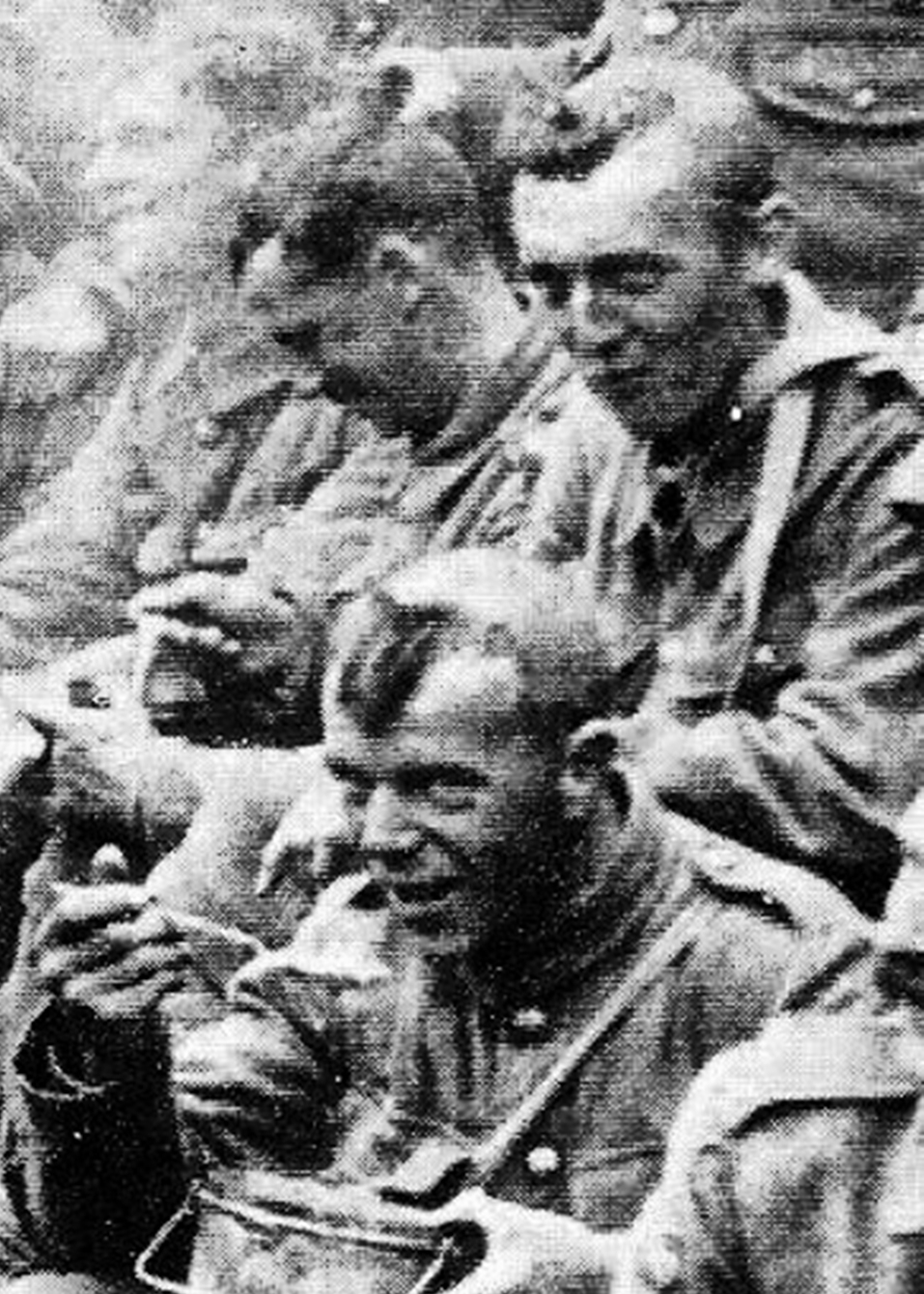
…and seen in a more extreme form here, these two men (brothers, surely?) sporting the shaved head and the, er, ‘forehead-mop’, for want of a better expression. So why would you choose to wear your hair like this? The most obvious reason would be hygiene,…

…or perhaps it was a practical measure, in case of a head wound. Sensible, that. But either way, why leave any hair at all?

Was this style, perhaps, a response to the introduction of the steel helmet, it being more comfortable, or less hot, with essentially a crewcut beneath, the mop protruding under the helmet adding some humanity to the regimented soldier beneath?

There seems to be no practical reason to leave a mop of hair at the front of the head, and thus one assumes it can only be a style, an affectation, a fashion statement.

Nor can I remember seeing any of the regulars who fought in 1914 with this style of haircut. This photograph shows a religious service in France held on 4th August 1918, the fourth anniversary of the outbreak of war.

And among various hairstyles, I spy two men with the forehead mop, in the centre of this close-up. The style seems to appear later in the war, perhaps with the arrival of the conscripted men who first arrived on the Western Front in 1916. Which suggests that it originated back in civvy street.

I have heard it suggested that this style originated among factory workers, but have never encountered any evidence to support this. Then again, I may not have seen many photos of industrial workers of the war period. The above picture, with at least one ‘forehead-mop’ on show, was taken in the spring of 1918.

Or could, as I have also seen suggested, this have been a gang haircut? There was, after all, many a gang loitering around the streets of post-Edwardian Britain. And I dare say many a gang member found himself conscripted in 1916, if he and his mates hadn’t joined up together before out of patriotism, much as the Pals battalions came into being. Or disappeared into the ether until hostilities ceased. Was this hairstyle the equivalent of a Hell’s Angel’s colours? Brothers in khaki. I do hope so.


Even two of these under-age soldiers in the front row, and another behind them on the left, are devotees of the forehead mop. Kids, eh?

Or maybe this explains it. Simple as that. Life’s a compromise, after all.
Ronaldo for Brazil in the World Cup Final 1998 carried on the tradition!
Heh heh. Indeed he did!
I’ve seen this cut in recent wars – Iraq and Afghanistan in particular – usually Americans. So I do wonder if it’s something to do with helmet comfort. Which, if so, goes to show that a century of evolution of the “tin hat” hasn’t greatly improved the lot of the infantryman.
It’s a teaser, eh, AJ?